

Israeli troops suppress the protests with live bullets, rubber-coated munitions, and tear gas, wounding dozens. 1,500 Palestinian prisoners are on hunger strike to demand improved conditions, an end to administrative detention.
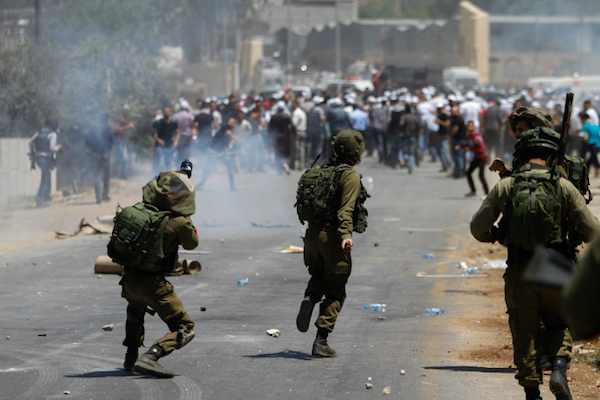
Thousands of Palestinians held protests in at least a dozen locations around the West Bank and East Jerusalem on Friday as part of a “day of rage” in solidarity with hunger-striking Palestinian prisoners, some 1,500 of whom have refused food in Israeli prisons for the past 12 days.
Israeli military forces shot at least seven protesters with live bullets, according to Palestinian news agency Ma’an, and dozens others were wounded by rubber-coated bullets, being struck by projectile tear gas canisters, and tear gas inhalation.
Protests took place in Nabi Saleh, outside the Ofer military prison, in the city of Silwad, in Sinjil, at the Qalandiya checkpoint, in Bethlehem, the Nablus-area town of Beita, al-Naqura, Awarta, al-Arrub, Beit Ummar, at a checkpoint near Qalqilya, Jenin, and in Kafr Qaddum.
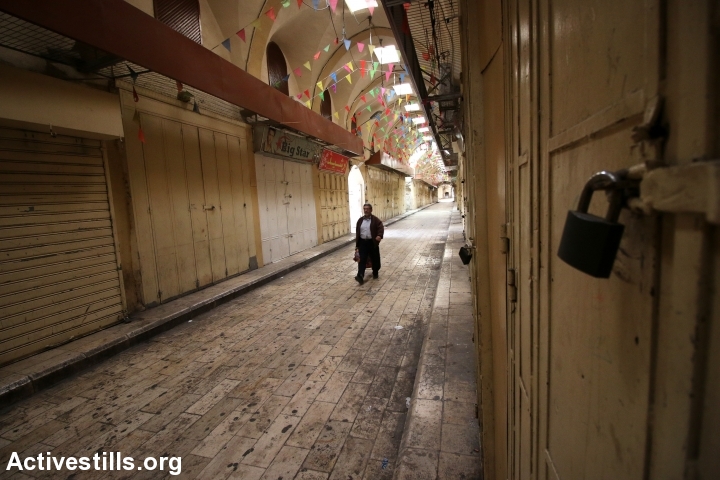
The day of rage followed a general strike in solidarity with the prisoners, which shut down commerce in Palestinian cities across the West Bank and in East Jerusalem on Thursday.
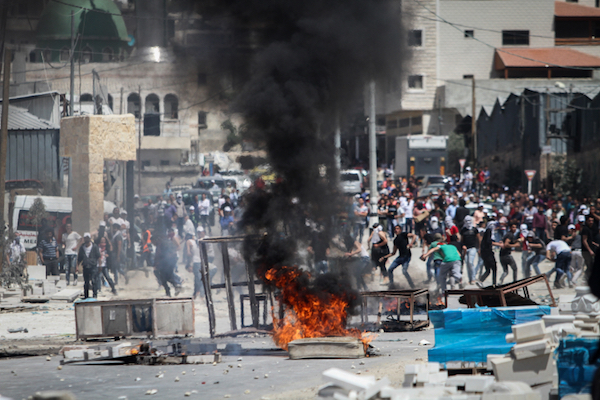
Smaller protests have been taking place on both sides of the Green Line for nearly two weeks, outside Israeli prisons and also in town and city centers.
At least 1,200 Palestinian prisoners are taking part in the now-12-day hunger strike, demanding improved conditions in Israeli prisons. Among the demands of the prisoners are: an end to administrative detention, more family visits and more phones for contacting family, access to education, and an end to the use of solitary confinement. Prisoners had access to many of the conditions now being demanded, but Israeli authorities revoked some of them as retribution for the 2006 capture of Israeli soldier Gilad Shalit and 2014 deadly kidnapping of three Israeli teenagers.
Individual hunger strikes have become more common in recent years, primarily undertaken by prisoners being held without charge or trial (in administrative detention), although larger groups of Palestinian prisoners have also launched larger hunger strikes over the years.
Civil rights group Adalah filed an emergency petition with the High Court of Justice on Thursday demanding that the Israel Prison Service (IPS) allow the hunger-striking prisoners visits with their lawyers; prison officials have been preventing them from meeting with attorneys as punishment for not eating. Preventing lawyer visits with prisoners as a punitive measure is a direct contradiction of previous Supreme Court rulings, the civil rights group said, and asked the court to hold the IPS in contempt of court.
Israeli authorities are also taking other punitive measures against the hunger-striking prisoners, ranging from solitary confinement to transfers between prisons to the confiscation of radios and salt from prisoners’ cells, Haaretz reported on Thursday.
Israel is currently holding some 6,500 Palestinians in its prisons, including over a dozen elected members of the Palestinian parliament, and hundreds of others who are being held in administrative detention. Israel uses administrative detention to imprison Palestinians without having to prove they committed a crime, without allowing them to defend themselves in court against sometimes secret accusations, and can be extended indefinitely. Some Palestinians have been held in administrative detention for years.
While a significant number of Palestinians in Israeli prisons are accused or have been convicted of acts of violence, both against occupying soldiers and against civilians, many others are imprisoned for nonviolent, inherently political acts of resistance.
In the February 2015 trial of nonviolent organizer Abdullah Abu Rahme, for instance, Israeli military prosecutors sought a long prison sentence in order to deter what they called “ideological crimes” of political protest. Under Israeli military law, all protest by Palestinians is illegal in the West Bank. Israeli settlers living in the same territory, however, have the right to protest.
According to prisoners’ rights group Addameer, the Israeli military has detained or arrested some 800,000 Palestinians since the start of the military occupation 50 years ago — around 40 percent of the Palestinian male population in the territories.
Most of the prisons in which Israel holds Palestinian prisoners are outside the occupied territories, in Israel proper, another practice the hunger strikers are demanding an end to. Transferring prisoners outside of an occupied territory is a violation of international law.