
Israeli politicians endlessly chastise the Supreme Court for doubting the use of punitive home demolitions. So what do the politicians do? Blame the judges for defending terrorists.
By Frances Raday
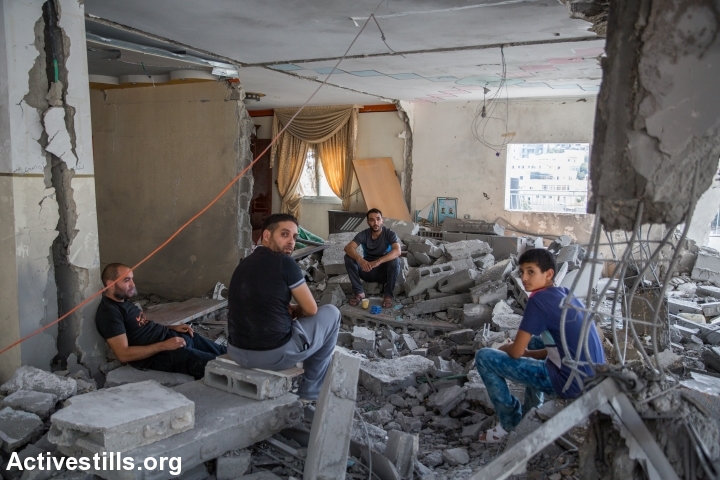
The spate of stabbing and vehicular attacks by Palestinian youths over the past couple of months has brought along with it a spate of punitive home demolitions targeting the attackers’ family members. Both political leaders and Israeli Supreme Court justices have had something to say about the practice. The justices have expressed some doubt about the practice, and in some cases even issued injunctions delaying the demolitions. In response, politicians have blamed the judges for defending terrorists.
The trail of “politicians’ blaming” and “judges’ claims” regarding home demolitions merits an English style lampoon and quiz.
The politicians and ministers in our government cry out: we must unite against our judges for delaying home demolitions of terrorists — they are siding with the enemy. It’s not a matter of human rights, they say, these teenagers’ parents must be punished for their sons’ or daughters’ offenses, here and now. Forcing the state to wait until it can present evidence to the court proves that the judges are completely detached from reality. The politicians seem to wish the judges would behave like the Red Queen, and order “off with their heads,” instead of “only by due process will we remove the roof from over their heads.”
Quiz 1: If this is not a matter of human rights, as Israeli politicians claim, then what is? Is the demolition of a home not a criminal penalty? As such, does it not require a fair trial of the accused and conviction of all who are to be punished, including each parent and all siblings? Are Arab parents more responsible for the murderous misbehavior of their offspring than Jewish parents? Has anyone considered punishing Yigal Amir‘s mother or Baruch Goldstein’s parents as a deterrent for the growing phenomenon of Jewish terrorism? Are our politicians unaware that their very own Defense Ministry concluded that efficacy of house demolitions as a counter-terrorism tool is questionable and hence should not be employed?
Our judges responded timorously: the politicians’ attacks on the judges are in such bad taste, they said. Such attacks pander to the public mood and are “are unworthy of our government.” One wily and wise judge asked: Who delayed the demolitions? Is the High Court really the cause of the delay when half of the disputed demolitions were not carried out even months after the court permitted them? And the champion of the judges, Justice Elyakim Rubinstein, took a stronger stand, saying the court had acted correctly in delaying the demolition until petitions against them were heard; if not, “We would be like Sodom and Gomorrah – destroying first and asking questions after!” He explained: “The court is part of the nation and the state, it is not the United Nations but it fights for the character of the state as a state of law, human rights and human obligations.”
Quiz 2: Are these attacks by our politicians really “unworthy of our government”? Are they not quite reflective of our present government whose ministers manifestly show little respect for human rights and the rule of law?
Quiz 3: What did our dear justice mean when he said the court is “not the United Nations?” In aiming to convince the public that the court is not alien to Israeli society did he not, perhaps inadvertently, pander to the public phobia about the international human rights regime, reinforcing a perception of meddling foreigners, along with isolation and victimization by the United Nations, which those very politicians who attack the court actually nurture? Did the learned judge miss out on that part of Jewish history in which it was the United Nations that gave birth to the State of Israel, which introduced international Holocaust Remembrance Day, which fights human rights violations affecting minorities, women, children, the disabled and the poor globally? Does our Supreme Court justice not fully acknowledge that the court itself is bound by the international human rights regime that prohibits punishment without due process or discrimination on grounds of race, religion or nationality?
We are indeed not cognizant of the UN. And we are worse off for that.
Frances Raday is the President of the Concord Research Center for Integration of International Law in Israel and a Professor of Law at Hebrew University.