

Demolitions leave dozens of Palestinians without homes or water

Recent wave of home demolitions has left dozens of Palestinians in the Jordan Valley without a roof over their heads just days before a rainy weekend.

Photos and text by Keren Manor and Oren Ziv / Activestills.org
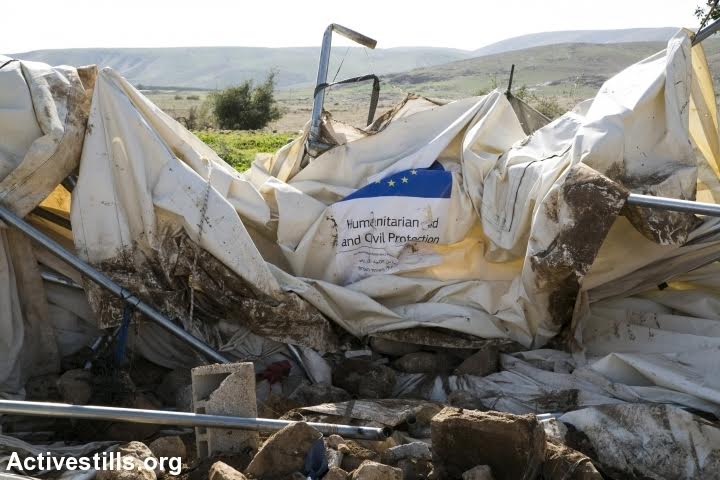
A demolished home donated by the European Union, Fasayl, Jordan Valley, West Bank, February 11, 2016. (photo: Activestills.org)

Israeli authorities accompanied by bulldozers demolished dozens of structures in several Palestinian villages in the Jordan Valley on Thursday.

The demolitions, which affected the al-Farisiya and Betardel communities, respectively, came a day after Israeli authorities demolished seven homes and six structures in two other villages in the area, leaving 71 Palestinians homeless.
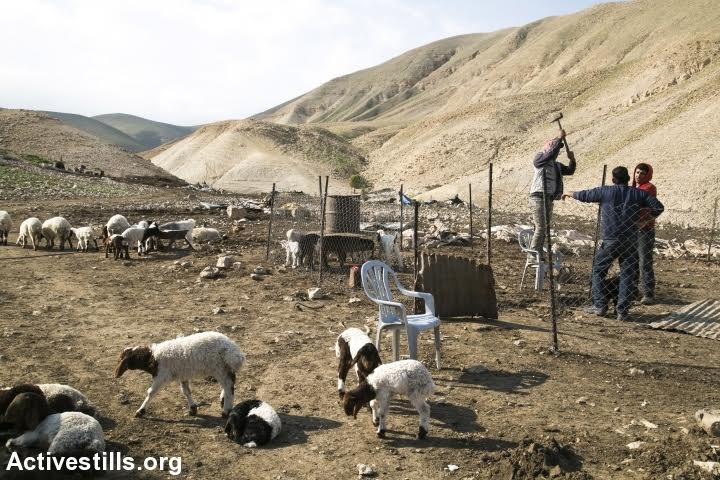
Palestinians build a temporary shelter for their animals following demolitions in Karzalya, Jordan Valley, West Bank, February 11, 2016. (photo: Activestills.org)

According to Israeli human rights group B’Tselem, this is the largest wave of demolitions in the Jordan Valley in recent memory. Over the past few weeks, Israel has stepped up its demolitions in Area C of the West Bank, under full Israeli military and civil control.

Wednesday’s demolitions began in the village Jiflik, where authorities destroyed five homes and a water pipe connected to 50 houses, leaving 300 Palestinians disconnected from the water grid.

Authorities then moved to the village of Fasayil, where they demolished a home provided by the European Union following a previous demolition last year, as well as an animal pen and a bathroom.
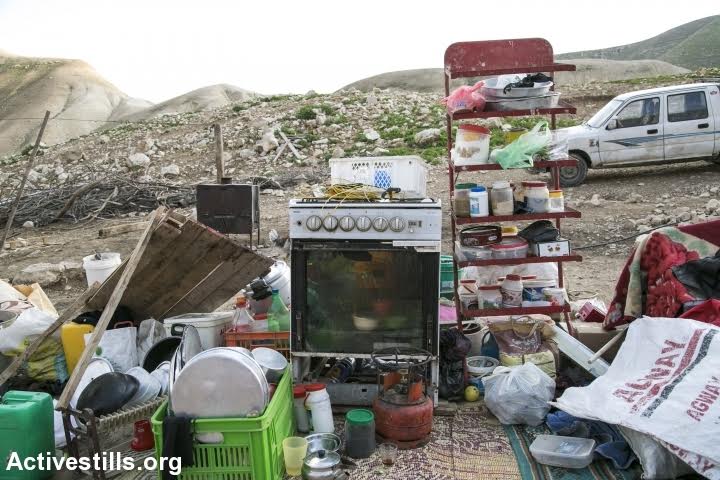
The belongings of a Palestinian family seen following demolitions in Karzalya, Jordan Valley, West Bank, February 11, 2016. (photo: Activestills.org)

In the tiny Karzaliya community, located next a spring approximately three miles from Route 90, Israeli authorities demolished two homes, a structure for animals, and a restroom. On their way out, the Israeli army built a ditch and piled up rocks in order to block the dirt path that connects the community to the main road. The Karzaliya community was demolished three times last year.

The army also demolished two tents in the village of Al-Miksar.
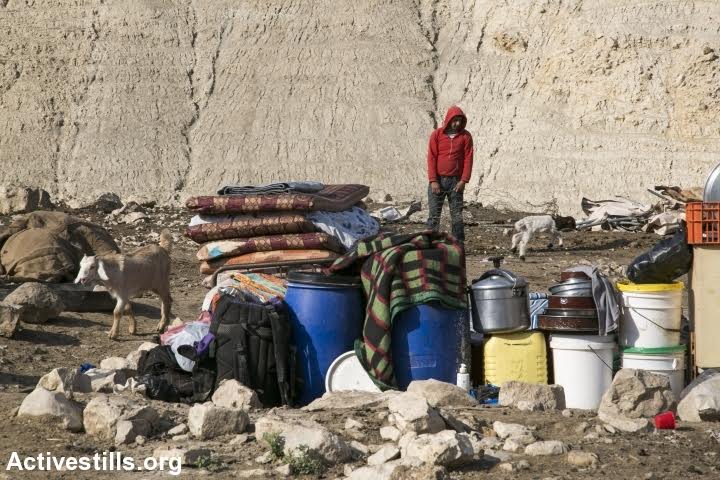
A Palestinian boy stands beside his family's belongings following demolitions in Karzalya, Jordan Valley, West Bank, February 11, 2016. (photo: Activestills.org)
A Palestinian boy stands beside his family’s belongings following demolitions in Karzalya, Jordan Valley, West Bank, February 11, 2016. (photo: Activestills.org)

The Israeli authorities argue that the demolitions take place only when Palestinians build illegally — that is, without building permits — or in live-fire areas. This, despite the fact that some of these communities own the land, and the vast majority of them have been living in the area since before the occupation of the West Bank in 1967.

As a rule, Israel does not allow Palestinians to build in Area C — which makes up more than 60 percent of the West Bank. In the past, the army has admitted that creating live-fire training zones in the West Bank is intended, among other things, for the purpose of expelling Palestinian communities.

In recent months it seems that the state is pressuring Palestinian residents of Area C to leave. Last week, the army demolished dozens of homes in Firing Zone 918 in the south Hebron Hills. The demolitions were halted midway following an intervention by the High Court of Justice. In January, the IDF began training in a live-fire zone in the northern part of the Jordan Valley, forcing two more communities to leave their homes during the training.

This article was first published in Hebrew on Local Call. Read it here.

Newsletter banner

End of article module for Members

TEST TEST GAL Our team has been devastated by the horrific events of this latest war. The world is reeling from Israel’s unprecedented onslaught on Gaza, inflicting mass devastation and death upon besieged Palestinians, as well as the atrocious attack and kidnappings by Hamas in Israel on October 7. Our hearts are with all the people and communities facing this violence.    We are in an extraordinarily dangerous era in Israel-Palestine. The bloodshed has reached extreme levels of brutality and threatens to engulf the entire region. Emboldened settlers in the West Bank, backed by the army, are seizing the opportunity to intensify their attacks on Palestinians. The most far-right government in Israel’s history is ramping up its policing of dissent, using the cover of war to silence Palestinian citizens and left-wing Jews who object to its policies.   This escalation has a very clear context, one that +972 has spent the past 14 years covering: Israeli society’s growing racism and militarism, entrenched occupation and apartheid, and a normalized siege on Gaza.   We are well positioned to cover this perilous moment – but we need your help to do it. This terrible period will challenge the humanity of all of those working for a better future in this land. Palestinians and Israelis are already organizing and strategizing to put up the fight of their lives.   Can we count on your support? +972 Magazine is a leading media voice of this movement, a desperately needed platform where Palestinian and Israeli journalists, activists, and thinkers can report on and analyze what is happening, guided by humanism, equality, and justice. Join us.

Make a Donation