The residents of Walajeh, who have long suffered abuses under occupation, will no longer have access to their spring.
By Laura Wharton
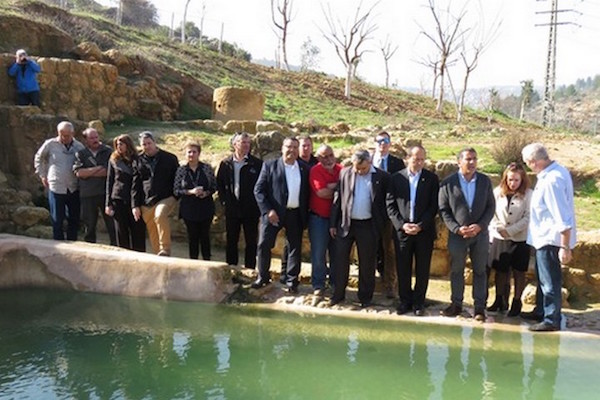
The smiles in the picture above represent the cynical face of the occupation. There are a number of male officials in the picture, and very few women, standing and smiling next to the Ein Hiniyeh spring, marking its re-opening, as well as that of a nearby archeological site to the public.
“This site will allow tourists and residents from Jerusalem and beyond to enjoy a beautiful area with a unique view in the hills of Jerusalem for free,” announced Minister of Environmental Protection and Jerusalem Affairs Ze’ev Elkin. However, Elkin forgot to mention the residents of the neighboring village of Walajeh, who previously enjoyed access to the pool — until now.
The celebration of the site’s re-opening, which brought together Elkin, Jerusalem Mayor Nir Barkat, his deputy Moshe Lion, and others, also marked the removal of the Palestinian residents of Walajeh from the area. By moving the checkpoint that leads to Jerusalem to the other side of the pool and archeological site, the Israeli government has blocked the Palestinians from entering, as they have done for many years.
This is not the first time that the residents of Walajeh have been expelled from the land and water that forms their livelihood. They first arrived to the area after Israel’s War of Independence, after fleeing from a nearby area that had fallen under Israeli control. After the Six Day War, most of the land around the village was annexed to Israel. Yet their homes remained beyond the boundaries of the Jerusalem municipality. They lack the blue ID cards that the other Palestinian residents of the city received.
The village’s proximity to Jerusalem proved to be its undoing. The Israeli government decided to separate the village’s residents from their land, first by declaring the village’s agricultural lands a “national park,” something Israel often does to isolate Palestinian villages. Then the village residents suffered harassment from the Israeli parks authorities. Israel built the separation wall in such a way that it cuts off the village from its agricultural lands.
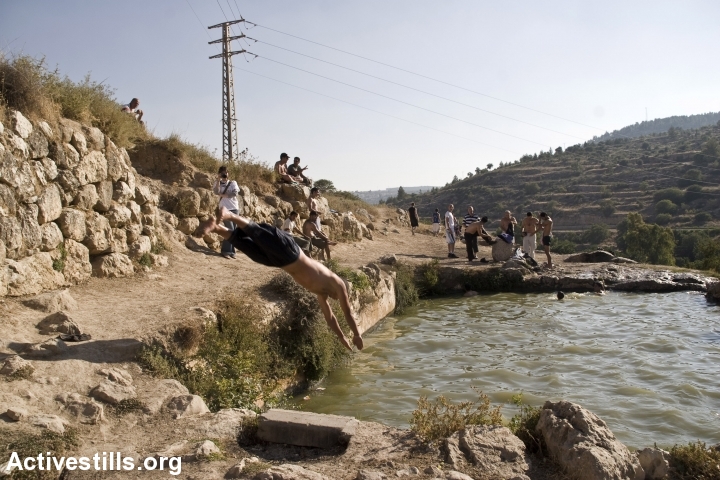
Then, quietly, and in contravention of the municipal planning committee’s legal advisor, the municipality moved the checkpoint to enter Israel beyond the Ein Hiniyeh site. Until then, Palestinians and Israelis alike used the site as a picnic spot, including many residents of Walajeh. Now Palestinians cannot access the spring next to their houses. They must watch from afar as Israelis enjoy the small park that was taken from them.
The Israeli government de facto annexed the spring to Israel and barred access to the residents of the neighboring village of Walajeh. Why? Simply because it can.
The officials who attend the Ein Hiniyeh reopening ceremony did not care that they were smiling for pictures next to a site that until very recently had been open to Palestinian families. They did not care that the children of Walajeh, who once used the spring to swim and play, will be forced to watch the Israelis who took their place. Not one of the officials asked themselves what kind of impact this has on a Palestinian child who watched the spring next to his house stolen from him? Who will this cause him to hate? For that Palestinian child, the officials’ smiles were smiles of evil and indifference — the faces of the occupation.
Dr. Laura Wharton is a Jerusalem city council member from the Meretz party. This article first appeared in Hebrew on Local Call. Read it here.