

On the same day the EU adopts guidelines for labeling settlement goods, the Knesset passes a preliminary reading of a bill to prevent entry to individuals who support a boycott of Israel.

The European Union approved a plan Wednesday to begin labeling goods produced in West Bank settlements, raising the ire of the Israeli government, even prompting a response from Prime Minister Benjamin Netanyahu. On the very same day, the Knesset approved a preliminary reading of a bill to ban individuals who call for a boycott of Israel.
“The Israeli economy is strong and will withstand this, those who will suffer will be the Palestinians who are employed in Israeli factories,” Netanyahu said in response to the EU decision, adding that the union “should be ashamed” and that Israel is “unwilling to accept the fact that the EU labels the side being attacked by terror.”
According to the guidelines, the EU does not recognize Israeli sovereignty beyond the Green Line, regardless of how those territories are regarded by Israeli law. EU member states will determine which punishments they will enforce on anyone who does not abide by the regulations (the regulations require states to levy sanctions against those who violate them). The European Commission will retain the option of opening proceedings for clarifying violations in the event that member states do not deal with the matter themselves.
According to Haaretz’s Barak Ravid, EU Ambassador to Israel Lars Faaborg-Andersen was summoned to the Foreign Ministry in Jerusalem to be reprimanded for the decision on Wednesday evening.
A statement by the Ministry of Foreign Affairs condemned the EU for choosing “for political reasons, to take such an exceptional and discriminatory step, inspired by the boycott movement, at a time when Israel is confronting a wave of terrorism targeting any and all of its citizens,” adding that “it is puzzling and even irritating that the EU chooses to apply a double standard concerning Israel, while ignoring that there are over 200 other territorial disputes worldwide, including those occurring within the EU or on its doorstep.”
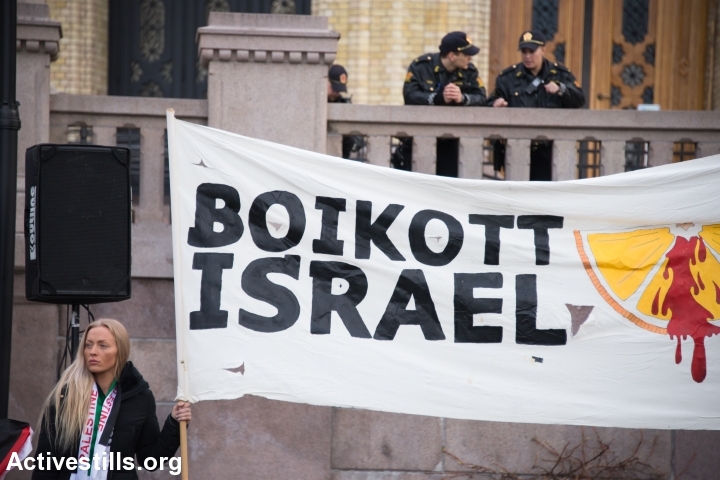
Over 550 Israelis, including former Knesset Speaker Avraham Burg and political scientist Zeev Sternhell, published a petition Wednesday in support of the EU’s decision, saying that Europe’s distinction between Israel and the settlements is a “step that could help promote a peace agreement, and it will also strengthen Israel’s overall status in the world and will undermine attempts to delegitimize it.”
Earlier Wednesday the Knesset approved the first reading of a bill that would forbid entry into Israel of anyone who calls for a boycott against Israel.
According to “Law Preventing Harm to the State of Israel by Means of Boycott – 2011” a boycott against the State of Israel is defined as: “deliberately avoiding economic, cultural or academic ties with another person or body solely because of their affinity with the State of Israel, one of its institutions or an area under its control, in such a way that may cause economic, cultural or academic damage.”
Although the it has only passed the first of several legislative steps, the government has thrown its support behind the bill.