
In at least two major decisions, Israel’s top court has shown it is prepared to uphold grave breaches of the Fourth Geneva Convention amounting to war crimes, and to give its implicit endorsement to unlawful discrimination.
By Gerard Horton
Sitting as the High Court of Justice, Israel’s Supreme Court has heard thousands of petitions submitted on behalf of Palestinians living under military occupation since 1967. This gives rise to an unusual situation whereby the highest civilian court in Israel permits individuals, who could be considered as enemy aliens, to submit petitions challenging the actions of Israel’s military in occupied territory.
Some use this as evidence to argue that adequate domestic remedies are available to Palestinians, which in turn creates the impression that no international judicial scrutiny or intervention is warranted. The strength of this argument needs to be assessed with reference to a number of the Court’s decisions.
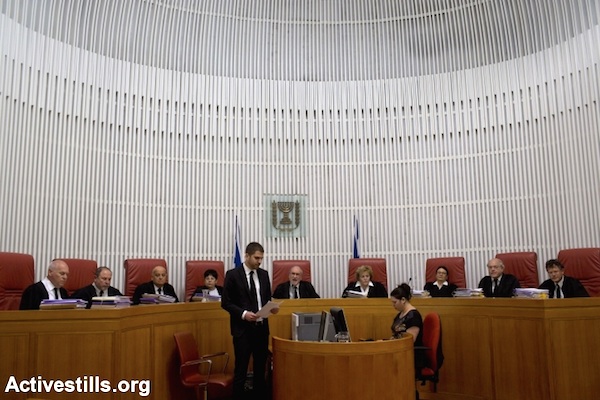
In 2010, the Court was petitioned in the case of Yesh Din v Minister of Defense on behalf of Palestinian prisoners from the West Bank who were transferred and detained inside Israel. The transfer and detention of Palestinian prisoners outside the West Bank is permitted under Israeli law (Regulation 6 of the Emergency Regulations) but prohibited under international law (Articles 49 and 76 of the Fourth Geneva Convention).
In upholding an earlier decision (the Sejadia case), the Court held that where primary Israeli legislation and international law directly contradict each other, domestic Israeli law prevails, making the transfer lawful. However, basic international legal principles establish that no state may invoke the provisions of its internal law as justification for its failure to perform a treaty obligation (Article 27 of the Vienna Convention on the Law of Treaties reflecting customary law). Accordingly, provisions of the Fourth Geneva Convention prevail over Israeli domestic law where the two are in conflict, making the transfer and detention of prisoners outside the West Bank illegal. Be that as it may, approximately 90 percent of Palestinian prisoners continue to be transferred and detained inside Israel.
In 2014, the Court was petitioned in the case of the Ministry of Palestinian Prisoners v Minister of Defense on, inter alia, the legality of applying different time periods within which a suspect in the West Bank must be brought before a judge, depending on whether he or she is Palestinian or an Israeli living in a settlement. The current Israeli legal regime operating in the West Bank applies military law to Palestinians and civilian law, with far greater rights and protections, to Israeli settlers.
Accordingly, the legal basis underpinning the petition was that no state is entitled to discriminate between those over whom it exercises penal jurisdiction based on race or nationality. In largely dismissing the appeal, the Court held that the differences in the laws applied to Palestinians and Israeli settlers were “fair and proportional” in the circumstances, in effect giving the Court’s imprimatur to a situation amounting to unlawful discrimination.
While it is true that Palestinians living under Israeli military occupation can access the Israeli civilian judicial system in certain circumstances, this is no guarantee that an effective remedy will be available in accordance with international law. On the contrary, as the two decisions referred to above illustrate, the Court is quite prepared to uphold grave breaches of the Fourth Geneva Convention amounting to war crimes (in the case of transfer and detention inside Israel) and to give its implicit endorsement to unlawful discrimination based on race or nationality.
It should also be noted that although Arabic is an official language of the State of Israel, these decisions are only officially available in Hebrew, making them inaccessible to the overwhelming majority of Palestinians.
Gerard Horton is a lawyer and co-founder of Military Court Watch. Gerard has worked on the issue of children prosecuted in the Israeli military courts for the past seven years and is the author of a number of leading reports on the subject.
Related:
Israel’s High Court legalizes segregated communities
How Israel increases its odds of international prosecution
Israel’s new Supreme Court: Liberalism don’t live here anymore


