

Over 1,700 structures were self-demolished by their owners over the past three years following pressure by police and state inspectors. Around half the demolitions were carried out in recognized Bedouin villages.
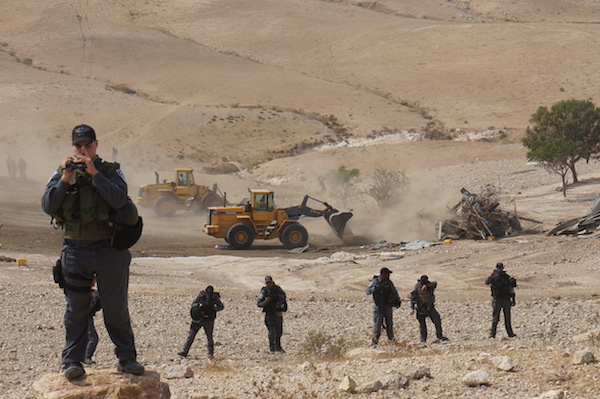
Israel demolished 1,041 Bedouin structures in the Negev between 2013 and 2015, with a further 1,711 structures being destroyed by their owners after receiving demolition orders, according to a new report by the Negev Coexistence Forum for Civil Equality (NCF). In 2015 alone, nearly 1,000 structures were demolished in the Negev — 365 by the Israeli authorities, and 617 by the homeowners themselves.
The waves of demolitions have displaced thousands of Bedouin over the past three years, according to Michal Rotem, the author of the report. Those who demolished their own homes were pushed into doing so by police officers and state inspectors, who frequently turned up at their door to put pressure on them. The same tactics were used to coerce around 210 home owners into demolishing their own homes even though they hadn’t received demolition orders, under the threat that one would be issued if their home stayed standing.
Most of the limited attention the situation of the Negev’s Bedouin receives tends to revolve around the area’s unrecognized villages — localities that the state does not recognize as legal, and which are therefore ineligible for basic municipal services and are not connected to electricity grids or water networks. These villages were the subject of the notorious Prawer Plan, currently back off the table, which sought to forcibly relocate the residents of these villages into designated townships. Some localities are still vulnerable to total demolition in order to be replaced with Jewish towns, as is the fate looming over Umm el-Hiran and Atir.
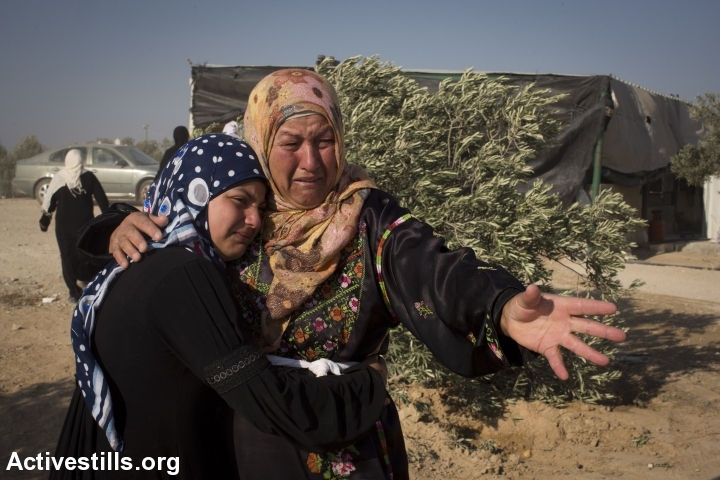
But according to statistics from the Southern Directorate, which oversees the demolition policy in the Negev, around half of these demolitions are carried out in recognized villages. In 2014, Rotem reveals, 46 percent of demolitions took place in unrecognized villages, while the remaining 54 percent were carried out in recognized villages.
This makes clear that the threats facing the Negev’s Bedouin residents extend far beyond the more publicized issues surrounding unrecognized dwellings. As the report states, while 34 percent of the population in the area is Bedouin, only 18 of 144 settlements are earmarked for these communities — a housing crisis greatly exacerbated by what even the Southern Directorate admits is a “gap…between the rate of enforcement [i.e. demolitions – nr] and the rate of housing solutions offered by the state.”
In a statement, NCF Executive Director Haia Noach accused the government of failing to work for the entire Negev population, instead “approving more and more Jewish settlements…while pushing the Bedouin community into crowded urban towns that cannot receive more residents.”
The relentless pace of demolitions in the Negev — outstripping even that in the West Bank — is in essence driven by a policy of ethnic discrimination, which sees land expropriated for JNF forests in addition to new Jewish settlements. In comments made last year following the approval of plans to build five new Jewish towns on top of Bedouin villages, Housing Minister Yoav Galant spoke of Israel’s “responsibility to settle the Negev … to turn it into a desirable and thriving area, in keeping with the Zionist vision.” The destruction caused by that vision is plain to see.