
Unlike satellite right-wing parties, Netanyahu advances the annexation of occupied Palestinian territories with little public scrutiny and at no cost.
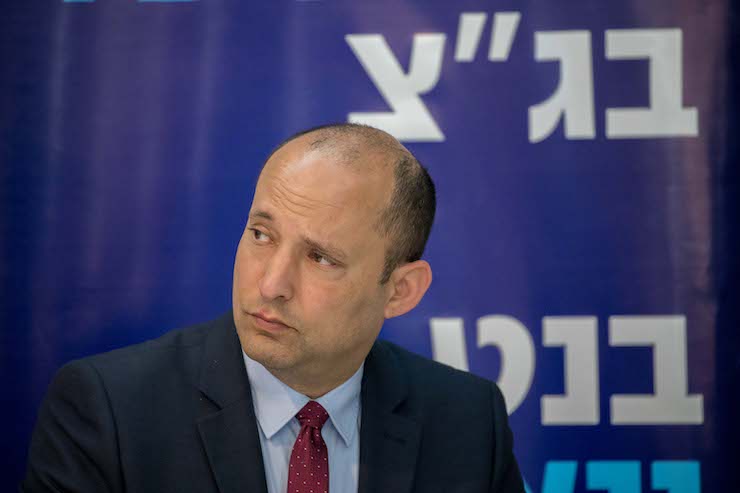
Israeli politics provide very few moments of relief for the beaten-down left. That Naftali Bennett’s “New Right” party might not make it past the election threshold, and that his political partner, former Justice Minister Ayelet Shaked, might have to beg the Supreme Court — which she so much abhors — to defend her political survival, are certainly two examples of such relief.
But the joy over Bennett and Shaked’s troubles, justified as it may be, must not interfere with our reading of the political map. The pro-settler right does not appear any more moderate — in fact, the opposite is true.
Yes, the hubris with which Bennett and Shaked resigned from the ultra-nationalist Jewish Home party and their decision to form another right-wing party most likely had a negative impact on their base. So too did Netanyahu’s last-ditch campaign — a scare tactic used to push people to vote — along with the fact that these elections were a referendum on the political legitimacy of a prime minister suspected of corruption. This, however, is only part of the story.
More than anything, Likud’s election victory teaches us that Israelis have internalized that it is more effective to promote a far-right agenda through an omnipotent ruler than through the establishment of satellite parties, which are easily labeled as extreme and are more susceptible to domestic and international scrutiny. In other words, right wing voters preferred actions over empty declarations.
Right-wing ideology, from Netanyahu to the last of the Kahanists, rests on four primary ingredients: absolute rule over Palestinians, delegitimization of Palestinians both as individuals and as a nation, eradicating democratic spaces, and Jewish supremacy.
Netanyahu has promoted each of these elements in frightening efficiency over the past decade. Annexation is not necessary to entrench Israeli control in the West Bank to the point of no return. In fact, it would be more potent to present it as a fact on the ground, through gradual ethnic cleansing of Palestinian communities in the occupied territories, enlarging the Jewish settler population, exploiting the West Bank’s natural resources, and obstructing any possibility for growth of Palestinian leadership, among other things.
To deepen incitement and delegitimization against Palestinian citizens, there is no need for hollow threats of a transfer; it is far more compelling to flag their very participation in the political game as an existential threat. The idea of Jewish supremacy renders partners from all Zionist parties, not only from the likes of Bennett or Kahanists such as Baruch Marzel. Even for the most extreme politicians on the far right, the blockade on Gaza and the deadly suffocation of its two million Palestinian residents are preferable over physically re-occupying the strip.
To some degree, this is a reproduction of the settler right’s successful tactics in the media onto the political sphere: rather than paint itself as an outsider group, the settler right has infiltrated the heart of mainstream media and is now dictating its tone. Based on that same logic, it is much more effective to empower Netanyahu and protect his legitimacy to ensure that he continues advancing pro-settler policies, without the public outcry that usually follows far-reaching political declarations.
More than any leader before him, Netanyahu has managed to destroy the faith in or desire for a political solution among the Israeli public. What remains is the idea of “managing the conflict,” meaning the continued control of Palestinians and the intensification of the occupation at no cost. In that sense, Bennett and Smotrich’s grand annexation plans are the millstone that would crush Netanyahu’s years-long policy of de facto annexation. When annexation takes place in practice, declarative outbursts suddenly seem puerile. The Israeli far-right has had an ideal prime minister in power for years, and the rational thing to do, as far as it is concerned, is to cement his power.
Thus, we should not be surprised by the failure of the ultra-nationalist, but by the fact that Netanyahu hasn’t snatched even more votes from the far-right. The prime minister is the rational choice for a wide spectrum of right wing voters, from Miri Regev’s supporters all the way to the Kahanists. What we’re witnessing today is the shrinking of that difference.
This article was first published in Hebrew on Local Call. Read it here.