Netanyahu recently proposed that Israel revoke the residency status of tens of thousands of Palestinians in East Jerusalem who live beyond the wall. This appalling idea will merely continue what is already in motion: years of ‘quiet transfer.’
By Hagai El-Ad
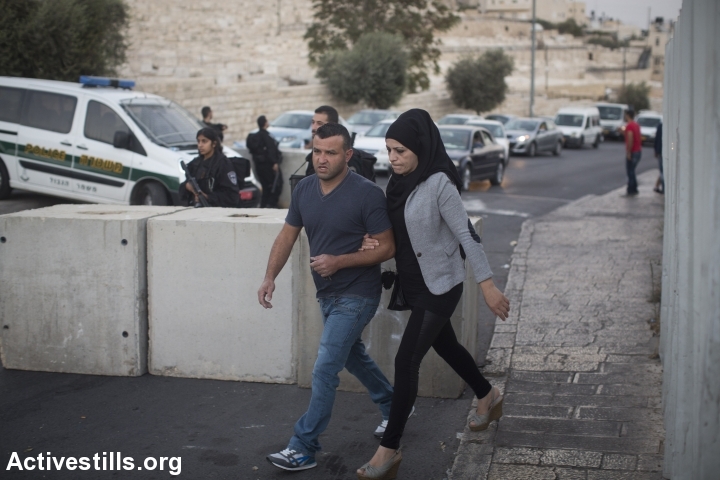
The latest proposed experiment to emerge from the Prime Minister’s Office – revoking the residency of Palestinians who live in the areas of Jerusalem that Israel abandoned east of the separation barrier – is, of course, disgraceful. The idea, which has since been rejected, exemplifies an instrumental approach to people based on racist demographic considerations, using revocation of residency to maximize territorial control while minimizing the presence of Palestinians in that territory, entailing various forms of human rights violations.
Netanyahu looks at Shu’fat, at Ras Khamis, at Samiramis, and at Kafr ‘Aqab and does not see people. He does not see more than 100,000 Palestinian residents of Israel – families who wish to earn a living; children in need of schools; individuals with personal, national and religious identities whose lives are intertwined with the city of Jerusalem. Instead, he sees a demographic bloc that can and should be removed.
This proposal may come as a shock but in fact, every part of it has already been successfully tried, and has been under way in Jerusalem for years. The only novelty is combining all these elements – status, territory, and demography – in a single initiative.
Change of legal status? Already happening. Since 1967, Israel has slowly but surely revoked the residency of more than 14,000 Palestinians in East Jerusalem. This “quiet transfer” – first exposed in a report by HaMoked and B’Tselem in 1997, almost 20 years ago – uses administrative excuses to revoke the permanent resident status that Israel gave Palestinians after annexing East Jerusalem. Since residency status can be revoked, the only permanent aspect of it for Palestinians is the possibility that it may be temporary.
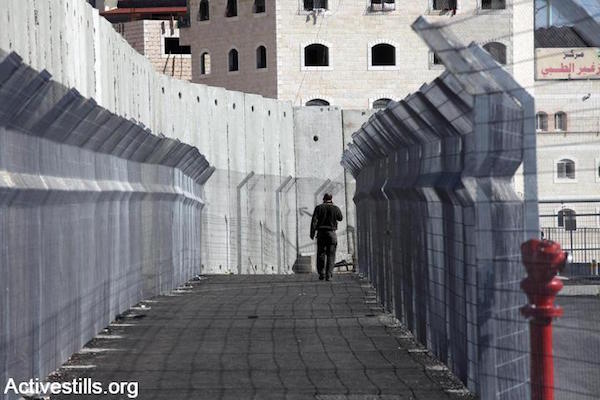
Physical separation from Jerusalem? Already happening. Many Palestinian neighborhoods in Jerusalem have recently been cut off from the city with roadblocks, hopefully only for the time being. Examples include Issawiya, Jabal Mukaber, a-Tur, and Sur Baher. Yet tens of thousands of Palestinians have lived like that for a decade, separated from the rest of Jerusalem by a high concrete wall. To enter their city they must go through a checkpoint — at Qalandiya or at Shuafat — often waiting for over an hour to pass.
Try and imagine yourself living like that, not for a day or two, but every single day. Every day, going through a checkpoint on your way to work, to university, to friends or relatives, to hospital, or to the mall. When the residents of these neighborhoods petitioned Israel’s High Court of Justice, the state was obligated to ensure that crossing checkpoints would be part of “a reasonable system of access to Jerusalem.” Readers are invited to visit the checkpoints at Qalandiya or Shuafat one morning and judge how “reasonable” the situation is. If you’re not sure, quiz yourself: how long could you live under such a “reasonable system?”
What the eye doesn’t see, the heart doesn’t miss? Already happening. Jerusalem is formally run by a single municipality responsible for rendering municipal services to all residents. In practice, Palestinian residents of the city who live beyond the separation barrier have evaporated, as far as the municipality is concerned. These residents have not had their status revoked, and the state is obliged to service them. So what?
The government and the High Court became party to a lie when the residents’ petitions were denied on the grounds that the separation barrier is reasonable and proportionate. This empty excuse is a shabby cover for artificially cutting entire neighborhoods off from Jerusalem. As the Association for Civil Rights in Israel (ACRI) recently wrote to the prime minister, the people in these neighborhoods find themselves living in a no man’s land, suffering a severe shortage of basic services – roads, classrooms, sewage, and more – in conditions that are quickly deteriorating into poverty, filth and crime.
For Netanyahu and for many others, Palestinians in Jerusalem are a nuisance at best. They are not seen as people with equal rights who live in their city along with the rest of Jerusalem’s “panoply of identities,” but rather as a security threat (from time to time) and as a demographic danger (always). Revoking their residency and removing them from Jerusalem? Israel has been doing that for years. Netanyahu said nothing new – he just suggested a step up in current policy. That is how it goes in Jerusalem: since 1967, dispossessing Palestinians in the city has become a tradition.
Hagai El-Ad is executive director of B’Tselem. This article was first published in Hebrew on Local Call. Read it here.