

My mother’s generation might have internalized the notion that AIPAC was all-powerful. But if the protests this week were a sign of anything, it is that America’s Israel lobby is not omnipotent.
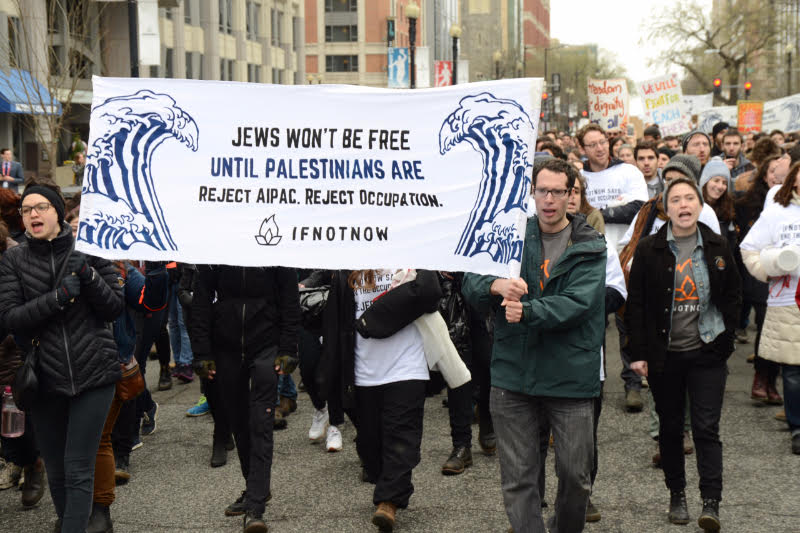
Watching the scenes from this week’s AIPAC protests, I was reminded of another, more amiable stand-off — this one with my Palestinian mother. I have tended to cite her more often since the last American election, not least because she is now on Facebook and has developed a habit of sending me short chat lines, like scribbled notes, reminding me to “please tell your children about the Lap Top” (a reference to the latest American travel restrictions) and other assignments I am not to ignore.
“Hands on” could not begin to describe this Palestinian woman’s parenting style, though that quality seems more endearing to me now than it did in my youth. When I was 18 and on my way back to college, she slipped away from the usual family goodbyes to secretly line my suitcase with bagged reminders of home — semolina date cookies, dried figs, and just enough stalks of tea-grade sage to offset the intestinal indignities of both.
But then, she found the book.
Anticipating my mother’s snooping, I had placed my copy of Paul Findley’s “They Dare to Speak Out,” face down, between stacks of neatly folded shirts, hoping that, if she found it, she might at least miss its incendiary subtitle: “People and Institutions Confront Israel’s Lobby.”
She didn’t. And just as sure as she read the cover of the 1985 bestseller — about “the pervasive influence of the American-Israeli [sic] Public Affairs Committee on American politics” — my mother from Bethlehem switched from stealthy to seething, losing her temper as only a Palestinian mother can.
“Samer!” she called out to me from my bedroom.
“What is this book?”
She wasn’t looking for a summation, of course. I was about to get a dressing down — about the dangers of wearing your politics on your sleeve, about never underestimating the gaze under which we Palestinians are held, and above all, about the futility of questioning the only thing more powerful than America: what she called “The Jewish Lobby.”
That was then. Today, a quarter-century later, I sent my mother a video of young Jewish-American activists disrupting — peacefully, boldly, beautifully — the annual AIPAC Policy Conference in Washington, DC. And this time, she didn’t reprimand me.
How times have changed. It was not long ago that reading Findley’s book at an American college seemed like a conspiratorial act, as if the contents somehow branded their consumer an enemy of the state. Never mind that the author was a former elected lawmaker or that the “people and institutions” he cites were in the public sphere, too. Such opinions were to be kept private, bandied about in Arabic with family or close friends — with those who could be trusted.
Implicit in these discretions was an unwritten rule that those who were not us could not be engaged in conversations about the Israel lobby, that only we were in on the secret, and that even those Americans who meant well would be better avoided, lest they expose us to the opprobrium of others.
As it turns out, my mother’s cautiousness was not entirely misplaced. Findley’s later association with the organization “If Americans Knew” placed him among a group of activists with whom major Jewish- and Palestinian-American leaders have refused to work. In a June 2015 statement distancing itself from IAK’s founder, Jewish Voice for Peace said that the group for which Findley is still listed as a board member advanced the notion that “only non-Arab, non-Muslim, non-Palestinian, and non-Jewish voices can be trusted to speak the truth….”
If my mother and others of her generation had unwittingly internalized that notion, only one group could have so effectively disassembled it for her. And this week, they showed up in force to take on the Israel lobby themselves. As one of the organizers, Shira Yudkin Tiffany, wrote in +972: “These were not your average AIPAC protesters.”
As a Palestinian who has attended his share of such protests, I do not think of our previous gatherings as average. But I would have to agree with Shira on this point. The Jewish Americans who gathered in Washington this week, brought together under the banner of the group IfNotNow, were “moved to act by moral anguish” over Israel’s 2014 war on Gaza, but they were also inspired by their own spiritual tradition.
Though that tradition is expressly Jewish, I think my mother can see in it a reflection of her own. In the Qur’an she keeps above her closet, Jews and Christians are referred to as “people of the book,” joined by a common scripture which dates back to Abraham. But in her tradition, Abraham has his doubts, too. When confronted with news of an all-powerful creator, he reacts cautiously, asking God to show him a sign (“to put my heart at ease,” he says).
Perhaps that skepticism has informed my mother’s own cautious approach to politics. But if the AIPAC protests this week were a sign of anything, it is that America’s Israel lobby is not omnipotent. That knowledge may not be enough to put a mother’s worrying heart at ease, but maybe next time, she can show up at the protest, too—with bags of date cookies and dried figs for all.


