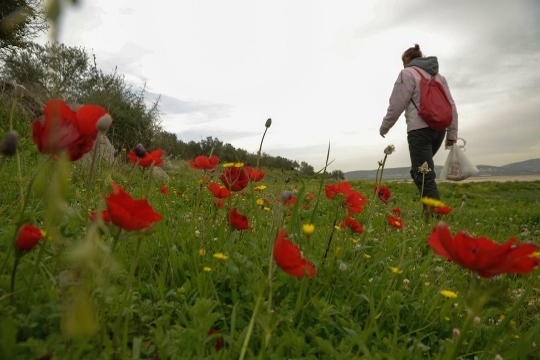
Walking in Palestine is a dangerous habit. But I walk because my country is small and getting smaller. I walk to make it big again.
By Bassam Almohor
I walk because my country is small — getting smaller, shrinking and vanishing. It is being fragmented, scattered into pieces, disconnected, or connected with thin, narrow corridors.
I walk to make it big again; I walk in valleys and canyons so that the land feels huge around me. I walk to make my country look vast and wide. I walk so I can spend weeks crossing it — to take photos, to smell fresh air, to get tanned, to feel free, to stretch my muscles, to relax my ears, to listen to the sounds of nature. I walk so I can feel that the whole country is my balcony. When I walk, Palestine is a continent.
I also walk for fitness. But, goodness me, even the Bedouin have stopped walking nowadays. Only their shepherds walk. I recently crossed Palestine and met only two shepherds, children picking za’tar (thyme), and a handful of hikers.
Everyone else drives. There is a taxi service in every village. A woman orders a taxi to visit her friend on the next street.
There are very few trails in Palestine. Most of the beautiful, old, natural ones became roads, savagely widened by bulldozers, criss-crossing olive groves and destroying the natural habitat. Of course, our “mashtoob” cars must drive.
“I can stay longer, even after dark, in my farm nowadays,” says Abu Mahmoud from the village Jammalah, while starting his old van. His donkey was recently retired, and is only used when his van runs out of gas.
There are very few people in the streets, or sitting on doorsteps, on their balconies, in a corner of an alley, sipping tea, coffee, and drinking glass-bottled Coca-Cola. There are very few cafes in the villages, no more little wooden chairs, and no more Abbas, our coffee man. He’s dead. I still remember him with his blue apron and never-smiling face, handing the old men their dark arabica, while playing tarneeb.
It’s the age of the Internet. What we call “social” is taking over. You meet people, exchange a few words, and the first question they ask you is, “do you have a face”? Yes, I do have a face, and a tongue, and I speak Arabic, and actually I’m good looking, and can tell you tons of stories, please sit with me and leave your “smart” thing aside. Not only have we stopped walking, we even stopped talking. What Paul Salopek calls “car brain,” I call “cell-phone brain.”
What is it? Why do people stop walking? Is it so hard? Is it that difficult to walk? Or is it dangerous? Is there a curfew? Or are the settlers roaming all around us — they slice up our roads and valleys, frighten our children, and we have to take every precaution not to stick our heads outside our windows, or not to step in their territories? Why did we stop walking?
Yes, the dark truth. Walking in Palestine is a dangerous habit. And thanks to Google Maps, I now see where the borders of the Jewish settlements are, I draw my path virtually, save the path from Google earth into a ‘.kml’ file, then use a free website to convert the ‘.kml’ file into a ‘.gpx’ file and upload it to my iPhone. Voila! I’m safe. Now I can consult my iPhone about where the nearest settlement is, and where its boundaries start, in order to avoid it. I thank every metaphysical element every time I bring my group safely back to its “natural habitat.”

But, come on! You don’t really need a GPS to hike, this is ridiculous. This place is so small that you can stand on a vista, look around you, and you can even touch the village, the farms, the valleys, the small Jordanian town of Shooneh, the towers of Tel Aviv, the red-roofed settlements. Oh, no, not these, they will burn you, that part is dark for us; to there we enter only if we are workers to fix their windows, and build their homes.
Walking is also dangerous if we want it to be so. Why do people think I am a Jewish settler every time I pass by a Palestinian village? Why do they say in Hebrew, “shalom,” “mi efo atem” (“where are you from?”), “rotse mayim?” (“do you want water?) every time I pass by a group of them? Why do a shepherd and his son run away with their 85 sheep in the hill over the village of Fandaqomieh? Is it because of our peaceful coexistence? Is it because of the settler, who looks like me, carrying a rucksack, wearing “North Face” and carrying a big Canon camera? But I don’t carry a gun on my hip.
Why does walking hurt? Is it because of the blisters on your foot? Or the sunburns? May be it is difficult because we have to climb. Our Palestine is hilly, for every path we go down, there is one to go up.
To be continued…
Read this article in Hebrew on Local Call here.
Related:
Yuval Ben-Ami’s ‘Round Trip’ walking tour series