
Netanyahu would like to include some centrist elements in his government in order to present a more moderate face to the world. However, any meaningful effort to end the occupation is not very likely.
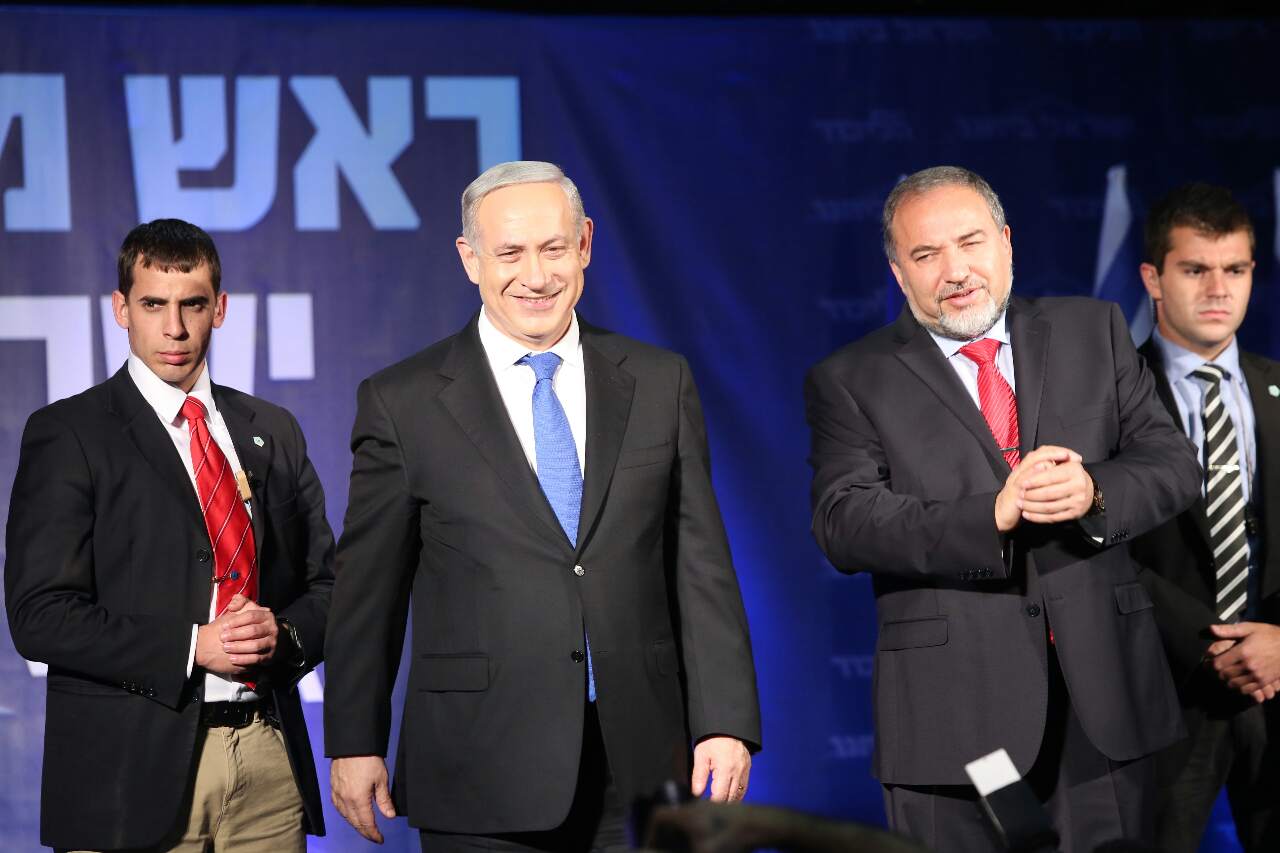
The Israeli post-election routine is under way, and tomorrow (Saturday) night, President Shimon Peres will officially ask Benjamin Netanyahu to try and form a new government. Netanyahu will have 28 days for his coalitions talks (which are already underway), and he may ask for an extension of 14 days.
While I do not have high hopes from the new government regarding the Palestinian issue, it is enough to examine Yair Lapid’s platform to understand how talk of a centrist or even lefty “victory” has been simply wrong – but the exact nature of Israeli policy will depend on the new coalition that will emerge.
Here is a quick rundown of the main options we face, and what each one means:
1. A narrow Bennett-Bibi-Lapid coalition. Probability: likely. This government would include Yesh Atid (Yair Lapid’s party), Likud-Beitenu (the Netanyahu-Lieberman joint ticket, which still operates as one bloc), Naftali Bennett’s hard-right Jewish Home party and two seats from Kadima. Altogether, that’s 64 seats. This government will concentrate on changing the status quo with the Orthodox parties, perhaps resulting in more ultra-Orthodox drafted to the army or joining the work force. The problem for Netanyahu is that this a very narrow coalition, which gives veto power to any one of his partners on any issue. Such a government won’t be able to do anything on the Palestinian issue, since it would include at least 20-25 members from the hard-right, both from the Likud and from Bennett’s list. Construction in the occupied territories will continue, as well as the effort to push the Palestinian population out of Area C (60 percent of the West Bank) – an essential part of the settler movement’s strategy right now.
2. A “wide” Bennett-Bibi-Lapid-Shas collation. Probability: likely. This coalition would be the same as the above option, but would include Shas. The coalition would be 74 seats strong, such that no party can force its policies. Wide governments tend to be reactive in nature and do not initiate major policy changes, as the prime minister always needs to look for consensus among the various elements (at the height of the Oslo process, for example, Prime Minister Yitzhak Rabin had a coalition of 61 MKs – the smallest Knesset majority possible). I think that this is Netanyahu’s preferred option, and I don’t see this government initiating major diplomatic moves for the same reasons listed under the previous option. An even wider coalition could include Tzipi Livni. The settlers will be a bit weaker in this government, so the colonization of the West Bank might not be as rapid – but it will certainly continue, along with some drama over the evacuation of certain outposts (the kind we saw over the last four years).
3. Narrow Shas-Lapid-Netanyahu collation. Probability: less likely. This coalition will include Shas instead of the hard right. In theory, such a government could initiate a settlement freeze or present a final agreement map (something Netanyahu refused to do in the past) as a way of restarting negotiations with the Palestinian leadership. This coalition – 64 seats, or 70 with Livni – would also enjoy the support of most of the opposition if it was to honestly engage with the Palestinian issue. Netanyahu’s problems would come from within, since many of Likud’s Knesset members oppose the very idea of a Palestinian state and thus could destabilize the coalition, forcing Netanyahu to depend on support from the left-wing opposition. Yet we should also remember that honest negotiations or even unilateral retreats will always carry a serious political price. Netanyahu could potentially have a majority to end the occupation, and his decision to avoid any step in this direction would not be the result of political circumstances, but rather of his own policy choices.
4. Very narrow Right-Orthodox government (hard-right coalition). Probability: unlikely. Netanyahu could easily form a government with his “base”: Likud, Shas, Jewish Home and United Torah Judaism. These parties have a 61-seat majority (Kadima with its two seats may also join). I believe this would be Netanyahu’s last option, since such a government would have serious opposition at home and would likely attract a lot of pressure from the world. Netanyahu has learned that he needs a buffer in the form of a centrist party, whose ministers conduct relations with Europe and the United States, to present a more moderate face to his extreme coalition. Naturally, a narrow right-wing coalition will not challenge the status quo on any one of the issues on the Israeli agenda. In the unlikely event that Netanyahu ends up with such a narrow government, he would at least try to have Tzipi Livni on his side, perhaps in the Foreign Ministry, and mainly for PR reasons.
There will be a lot of spin thrown around in the next month or so – such is always the case during the coalition-building period. Ultimately, I believe Netanyahu would rather close a deal with Lapid on many of the internal issues such as tax breaks for the middle class and military draft reform, rather than change his approach to the Palestinian issue. Most likely, he and Lapid will agree to “make every effort” to renew negotiations but not take actual, serious steps toward negotiations (A good litmus test for the “seriousness” of a government is the behavior of the settlers. When they leave the coalition and break the Likud in two, we will be able to assume something is really happening).
One last thing to remember is that military escalation – with Syria or Hezbollah for example – will make parties more likely to join the government, and at a much lower price.
Related:
+972 Magazine’s Israel elections page, with original commentary, analysis and news
The one good thing the next government could accomplish
Lapid’s platform: No compromise over Jerusalem, no settlement freeze