

The inaccessibility of Israel’s military procedures means Palestinians are often forced to navigate the labyrinthine bureaucracy of the occupation in the dark.
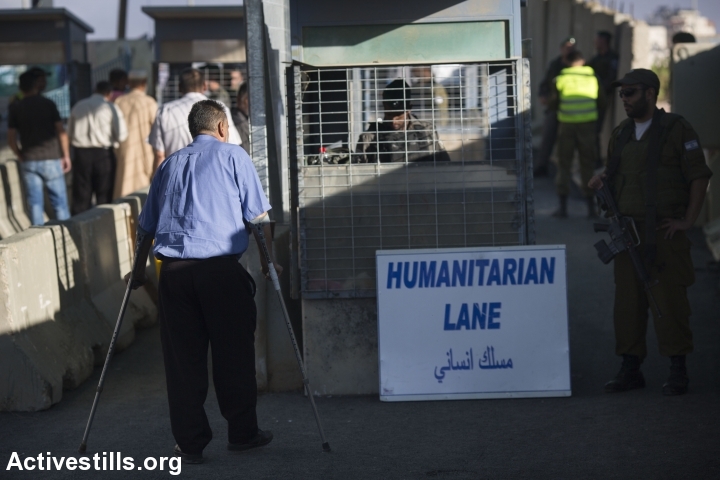
The Civil Administration, the arm of Israel’s military government that rules over 2.8 million Palestinians in the West Bank, has once again broken its own commitment to publish all its policies and procedures in Arabic.
After being slapped with a near-unprecedented rebuke by a Jerusalem District Court judge in May over its continuing failure to make these procedures available, the Civil Administration was ordered to finish translating and publish all of its regulations within six weeks of the court’s ruling, which was issued on May 3.
With the deadline having passed, Israeli human rights NGO Gisha — which has been petitioning the Civil Administration since December 2014 to publish all of its policies and procedures in Arabic, as per its obligations under the Freedom of Information Act — requested on June 21 that the state be held in contempt of court. The judge has given the government until July 10 to respond.
The documents in question dictate fundamental, day-to-day processes for Palestinians in the West Bank, such as obtaining travel and work visas, getting entry permits into Israel and dealing with medical requests. Palestinians’ ability to go abroad, attend weddings, visit sick relatives and live in one place or another are all subject to these procedures.
Access to this information in Arabic is therefore critical for Palestinians subject to Israel’s military regime, in order for them to know what their rights are and how they can claim them. The inaccessibility of this information means that in many cases, Palestinians are forced to try and navigate the labyrinthine bureaucracy of the occupation in the dark.

Moreover, says Gisha’s Legal Director Dr. Nomi Heger, the Civil Administration didn’t even honor its own commitments to the court. “The legal proceedings ended with an unequivocal, explicit verdict, after the Civil Administration committed yet again to publish all the remaining procedures but it failed to do so in Hebrew or Arabic,” Heger told +972.
Having now broken its own commitments six times in the past 18 months, the Civil Administration’s “contempt for the court and contempt for the public’s right to know are glaring,” she added.
In addition, many of the Arabic procedures have, according to Gisha, been poorly translated, making them difficult to understand. A number of them date back to 2012, meaning they have potentially been superseded by new regulations that are unavailable.
Meanwhile, the Coordination of Government Activities in the Territories — the body that oversees the Civil Administration, as well as Israel’s policies vis-à-vis the Gaza Strip — continues to trundle towards its self-appointed deadline of launching a fully-functioning website by August 2016, to replace the one that went down in June 2015. This website is the subject of a separate legal petition by Gisha, currently moving through the Tel Aviv District Court.
Throughout the entire period that their website has been down, however, COGAT has continued to maintain a Facebook page with limited and decontextualized statistics intended to demonstrate how Palestinians are benefitting from the occupation.
One might very well question why, when the tasks at hand are seemingly so straightforward, the Civil Administration and COGAT have apparently chosen the path of drawn-out, costly and at times embarrassing court procedures. There is probably no one definitive answer, but like all bureaucracies, Israel’s military government — the bureaucratic arm of the occupation — has its own internal logic.
As a government entity that is steeped in the arts of dispossession and control, the Civil Administration has a very clear purpose: to dictate the lives of Palestinians, whether by withholding land, freedom of movement or information. The Civil Administration follows the workings of all bureaucracies, which is to be self-fulfilling and self-perpetuating. And perhaps that’s the scariest thing about the occupation — it is engineered to sustain itself.
COGAT’s response: “The Civil Administration has published all the procedures in Hebrew as it obligated in accordance with the ruled date by the court. In the next days, all the procedures in Arabic will be publicized as well.”