

In Arab capitals speculation turns to panic about Trump’s expected reversal of policy on Jerusalem. Meanwhile, nobody seems to be talking about — or to — the Palestinians of Jerusalem, whose daily reality of occupation will remain irrespective of what comes next.
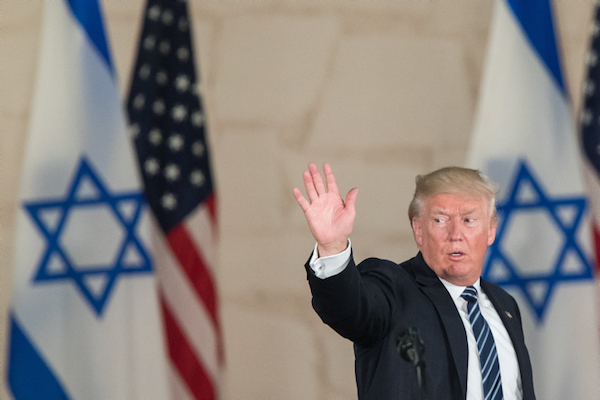
Speculation was rife on Tuesday that the U.S. president would soon break with the international consensus on Jerusalem, formally acknowledging it as Israel’s capital. Whether that acknowledgement would come in the form of a speech, a directive to move the U.S. embassy there, or both remained unclear as of this writing, but the prospect of such a dramatic break from longstanding White House policy seemed to evoke unrestrained panic in Arab capitals.
The official Saudi Press Agency ran a statement from the Kingdom’s Ministry of Foreign Affairs warning of “grave and negative consequences.” Jordan’s top envoy tweeted that the U.S. move would “trigger anger,” not to mention violate UN Security Council resolutions. And none other than Mahmoud Abbas cited the threat to “regional and global security and stability.”
Yet absent from the frenzy were Jerusalem’s Palestinian residents themselves, who just four months ago led a week-long nonviolent protest that rallied thousands of Muslims and Christians in what +972 Magazine’s Edo Konrad called an act of “mass civil disobedience.” At issue then was access to the Al Aqsa Mosque compound, which the Netanyahu government, against the advice of both the Israeli military and internal security service, had restricted by erecting metal detectors.
Writing at the time, another of my colleagues, +972 Magazine’s Amjad Iraqi, saw the protests as evidence of Palestinians “reviving their agency” in Jerusalem: “Christians and secularists were seen standing alongside conservative Muslims in prayer, affirming that the fight for Al-Aqsa is a national cause and not just a religious one,” he wrote shortly after the protests ended.
And yet, despite pressuring the government to remove the metal detectors, what Palestinians hailed as a triumph of peaceful protest was already being claimed by others.
Some press reports had it that Netanyahu had acceded, not to the protestors’ demands, but to a deal put forward by Jordan’s King Abdallah, who had sought some recompense for the murder of two Jordanian nationals by an Israeli embassy guard in Amman. That the guard was spirited away and later toasted by Netanyahu himself makes the reported trade-off plausible. Still, few seemed to acknowledge that the King’s hand, in fact, had been dealt to him — not through some diplomatic feat, but from masses of Palestinians who, by any practical measure, are represented by no one.
Consider, for example, that their nominal leader, Mahmoud Abbas, is — like every one of his Arab counterparts — forbidden from entering Jerusalem without Israeli permission.
That plain fact should give pause to anyone looking for meaning in these leaders’ statements. As for Trump, even as we brace ourselves for whatever proclamations he might issue from his dais this week, we would do well to remember that, for hundreds of thousands of Jerusalem’s Palestinians, the daily reality of the Israeli occupation will remain.
So, too, will the need to confront it.


