
Six months ago, there were five Arab republican dictators. Now, all but Syria’s president are out or on their way, and even Assad is facing his biggest challenge since succeeding his father a decade ago
The “Arab Spring” of the last six months has already swept away the dictators of Tunisia and Egypt. Libya’s ruler seems unlikely to survive, and the Yemeni president has agreed to step down in exchange for immunity. This means that the republican dictatorship, once an important type of regime in the Arab world, is on its last legs.
Or, more accurately, its last leg. Syria’s president, Bashar Assad, is facing the most strident and extensive wave of protests the country has seen for decades, and his bloody response has so far failed to suppress the demonstrators. Since Assad inherited his position from his father, it is reasonable to question Syria’s republican credentials, but even if they are sound, it is a dying breed.
Right now, half of the 16 independent Arab states in the Middle East and North Africa are traditional monarchies, where the king exercises supreme political authority. The Arab world holds quite a monopoly on this regime form, adhered to by only three tiny non-Arab states (Brunei, Swaziland and the Vatican).
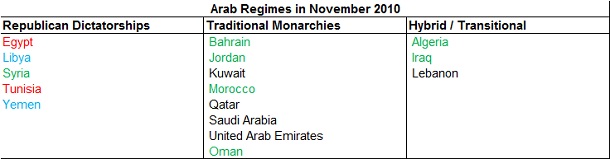
The other Arab states (aside from complicated exceptions like Lebanon; recently joined by Algeria and Iraq) have been republican dictatorships, headed by an autocrat supported by the military. Not anymore. This is how the 16 Arab regimes were divided in November 2010 (red signifies regimes that have since fallen, blue signifies regimes on their way out, and green signifies regimes shaken by massive protests):
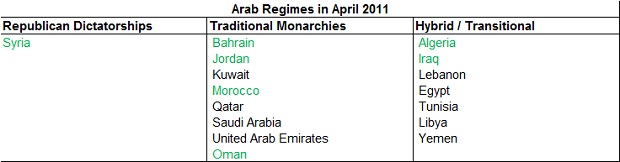
And this how the Arab regimes look six months later:
The picture looks even more impressive in a map form. This is how the Arab world looked in November 2010 (red signifies republican dictatorships, blue signifies traditional monarchies and yellow signifies countries in transition or hybrid regimes):
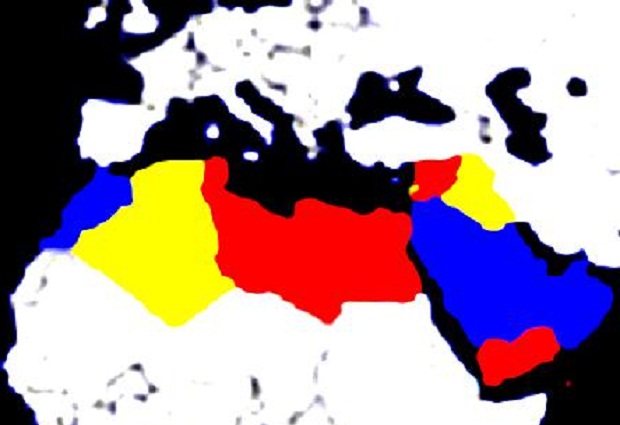
And this is how the Arab world might look if Syria’s regime is toppled:
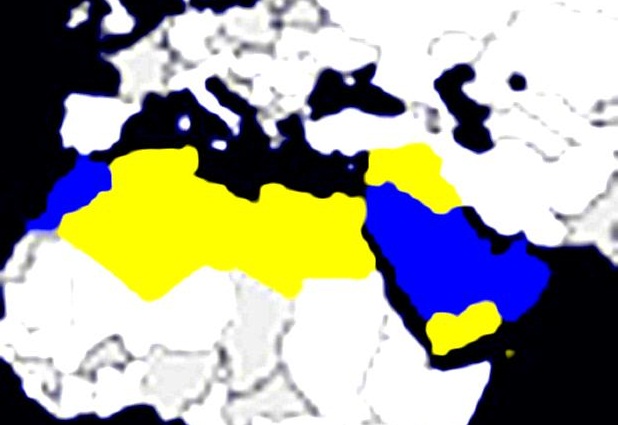
There are two main insights that can be gleaned from this data. First, anyone who still argues that the Arab turmoil of the past six months is unimportant is seriously deluded. We are talking about one of the most dramatic events in recent history.
Second, traditional monarchies have so far proven more resilient than republics (although the Bahraini royals probably owe their survival to Saudi intervention). Their enhanced sustainability may be due to the fact that those regimes that survived the pan-Arabic wave of the 1950 and 1960s (which toppled the monarchs of Egypt, Iraq and Libya), are probably more entrenched and adaptable. Most rely on oil income; but Jordan and Morocco have proven robust even without it. It remains to be seen if the Arab monarchs will continue to weather the current storms, or join their republican counterparts in the dustbin of history.