

B., an asylum seeker from Sudan, was reportedly stabbed by a group of Israelis just two weeks after he moved to the central city of Netanya. Days after regaining consciousness, he is still unable to speak.
By Oren Ziv / Activestills.org
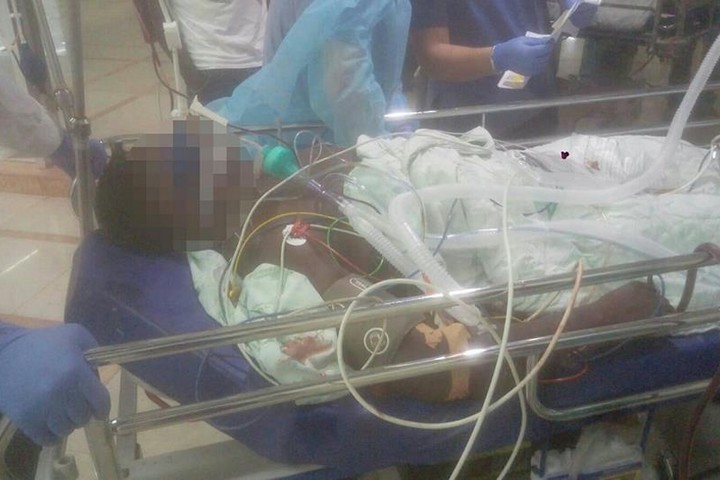
A Sudanese asylum seeker was stabbed by a group of four Israelis in the city of Netanya in central Israel on Sunday. Following the attack, the asylum seeker, B., lost consciousness and was hospitalized at Laniado Hospital. He regained consciousness on Wednesday morning, and is still unable to speak.
Jamal Ibrahim Adam, another Sudanese asylum seeker who shares an apartment with B. in central Netanya, said that B. had left to buy something at a corner store at around 8:30 p.m. Upon returning, he was attacked in the parking lot. “I was standing on the steps of our home on the ground floor. People began calling my name so I ran to the parking lot 50 meters away from our home. I saw four Israeli men, some of them wearing a kippa, running in front of me.”
“B. was on the ground,” Adam continued. “I turned him over and saw three stab wounds in his back, he was in bad shape. He managed to say ‘they stabbed me.’ His cellphone was in his hand. I lifted it to look at it, he had taken a photo of one of the stabbers.” According to Adam, the police took both him and the cellphone in for investigation, where Adam confirmed that the man in the photo was indeed present when B. was stabbed.
Adam says that passersby told him that the same group of Israelis had tried to attack an asylum seeker earlier that day, but had given up when they realized there were too many people around. He has no doubt that the attack was racially-motivated. “These are people who I saw for the first time. They came here to mess with refugees.”
Adam says he feels unsafe in Netanya. “It is scary to walk around at night. It is less safe for us here than in Tel Aviv. It is frightening to go outside. I go straight to work and back. I never leave the house alone.”
B. and Adam moved to Netanya only two weeks ago. B. had previously lived for a year in Holot detention center, and now he works in a construction site in the city. Since the stabbing, Adam has visited B. every day in the hospital. “The doctors say that the knife struck him in sensitive parts of his body, and that it will take another two weeks until we know anything. We can only pray.” Meanwhile, he believes the police won’t do a thing.
Israeli police issued the following response: “Following the incident, an investigation was opened and the circumstances were examined. Ut is not possible to provide further details on the ongoing investigation.”
This article was first published in Hebrew on Local Call. Read it here.