

Despite admitting that the young man was only looking for work, police decide to charge him with conspiracy to commit a crime — renting a rope and ladder.
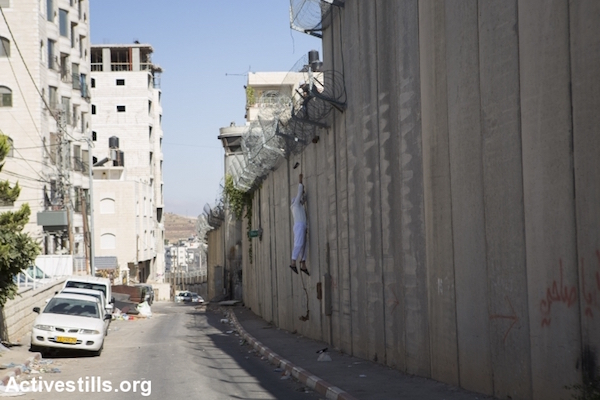
Israeli police prosecutors indicted a 26-year-old Palestinian man in the Jerusalem Magistrate’s Court Wednesday morning for climbing over the separation wall in order to find work.
According to the indictment, last Friday Muntaner Ben-Mahmoud Barakat went to the West Bank village of a-Ram, which is separated from the East Jerusalem neighborhood of Beit Hanina by the concrete separation wall. He paid somebody NIS 50 ($13) to use a ladder and rope to climb over the wall (which the indictment calls a “fence” for some reason), climbed over the wall, and made his way toward Damascus Gate in the Old City of Jerusalem to find work. Police arrested him before he got too far.
The two charges on the indictment are “illegally entering Israel” and “conspiracy to commit a crime,” which carries a penalty of up to two years in prison. The conspiracy? Renting a rope to climb a wall to find work.
It is worth noting that the indictment was filed by a prosecution unit belonging to the police and not the State Attorney’s Office. In the past, police have been known to file overly ambitious and severe indictments in cases where the state prosecution would not, and have even been ordered by the attorney general to drop certain prosecutions, most notably in the case of Daphni Leef and other social justice protesters.
Professional and government committees have been recommending for decades that the police stop acting as a prosecutorial body. However, despite a government decision 15 years ago to absorb the police prosecution unit into the State Attorney’s Office, police continue to file the vast majority (87 percent) of indictments in Israel.
“The fact that the police prosecution is subordinate to the police makes it difficult for the prosecution to fulfill the very purpose for which it exists: to represent the public interest objectively or quasi-judicially,” the Israel Democracy Institute wrote in a 2014 position paper. “[B]ecause the police prosecution is subordinate to the Israel Police, which is a hierarchical security body, the prosecution has an overly zealous tendency to achieve convictions and, thus, to ignore the mistakes and possible biases of the investigating body, namely the police.”
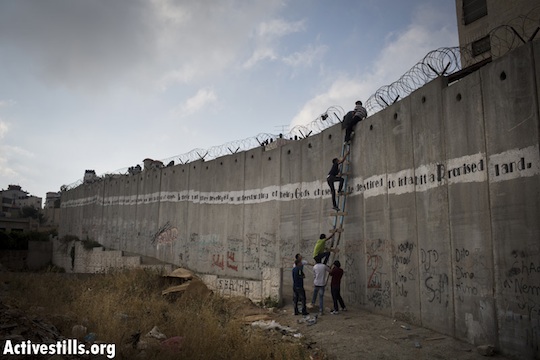
Beyond the overly ambitious charge sheet against Barakat, who even the state admits was just looking for work, it seems that the price of rope has skyrocketed in East Jerusalem.
Less than a year ago photographer and journalist Oren Ziv reported on Palestinian youths who climb over the wall in East Jerusalem for our Hebrew-language sister site, Local Call. In July of 2015, he found, it only cost NIS 20 ($5) to rent the requisite equipment.
Tens of thousands of Palestinian laborers illegally cross into Israel searching for work every day through holes in the fence, by climbing the wall, or simply crossing in areas where Israel has built no barrier separating its sovereign territory from the West Bank, which it rules under a military occupation.
Michael Schaeffer Omer-Man contributed to this report. A version of this article first appeared in Hebrew on Local Call. Read it here.