
Trump’s visit to Israel is just the latest thing to keep the Palestinian prisoners’ hunger strike — already largely ignored by the media — out of the headlines.
By Tanya Rubinstein
Donald Trump’s arrival in Israel on Monday filled social media with mockery and resentment, surrounding everything from ministers’ ridiculous statements and road closures to bizarre conversations and more.
The media also had a field day with Likud MK Oren Hazan’s selfie with Trump, and with the politics of who’d get to shake hands with whom during the welcoming ceremony at Ben Gurion Airport.
During the reception, Internal Security Minister Gilad Erdan told Trump that a Monday morning traffic accident in Tel Aviv may well have been a terror attack – despite the police having stated well over an hour beforehand that it had been an accident. But, as we all know, much of the internal security minister’s role these days involves wanton incitement and fabricating terror attacks, as we saw following the killing of “terrorist” Yaqoub Abu al-Qi’an in Umm al-Hiran.
But what’s happening behind all the media spin?
Only one Israeli media outlet, Haaretz, reported on how the ramping up of security for Trump’s visit — mostly based in Jerusalem — involved the deployment of around 11,000 additional police officers and the issuing of administrative orders against citizens who it was thought “may interfere with the visit.” Aside from the blocking of roads and traffic jams that inconvenienced everyone, we must also think about those whose own security and daily routine were affected because it was feared they might disrupt Trump’s visit.
Nir Hasson, writing in Haaretz, described how American and Israeli security services teams had descended on Jerusalem’s Old City ahead of Trump’s visit, describing “shops being searched with the help of a dog, before being shuttered and a blue security services sticker being placed over the lock, so that it couldn’t be opened without tearing the sticker.”
Hasson also described how surrounding roofs “had a camouflage net spread over them, while large temporary structures were erected wherever the president was expected to get out of his car.”
We were also told, one day prior to Trump’s visit, that the Israel Prison Service had started transferring hunger-striking Palestinian prisoners, who were then on the 36th day of their strike. Are their claims, demands and deteriorating health of any interest to the Israeli public and the media’s agenda-setters? Of course not. In fact, it suits the Israeli government very well to push this struggle for improved prison conditions and human rights to the margins, and away from the public discourse.
But perhaps we don’t have to accept this state of affairs. Perhaps, even, we are obligated to reject the spin. Maybe the choice over what we will listen and pay attention to is in our hands — we can take the story that has been pushed to the sidelines and spread it around, and acknowledge the people hidden behind the words “administrative orders” and “security.”
In the world of activism and organizing we sometimes shelve an event because we know there’s little chance of media coverage — it’s just as Trump is visiting, or just as Gilad Erdan is busy demonizing the same people whose basic rights we’re currently fighting for, and his voice is louder than ours.
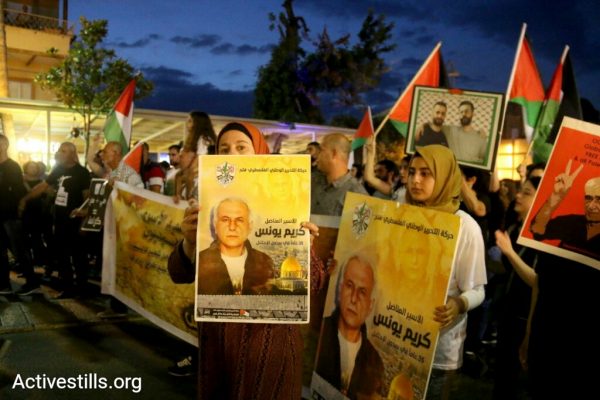
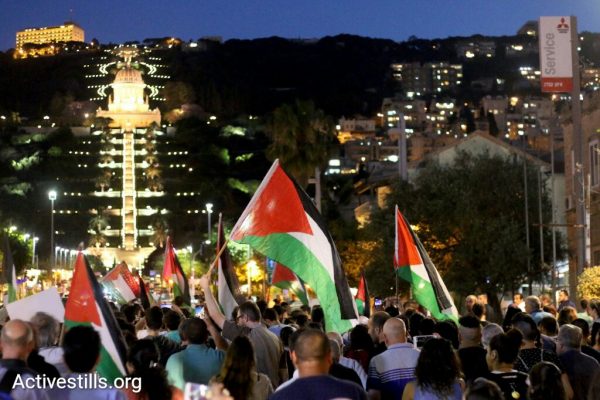
Nonetheless, demonstrations in support of the hunger-striking Palestinian prisoners took place across Israel and the West Bank on Monday, organized by the Jaffa Clock Square activists, because expressing support and solidarity is not a matter of spin. Let’s not allow ourselves to be spun as well.
Tanya Rubinstein is the Co-Coordinator at the Coalition of Women for Peace. This article was first published in Hebrew on Haokets.