
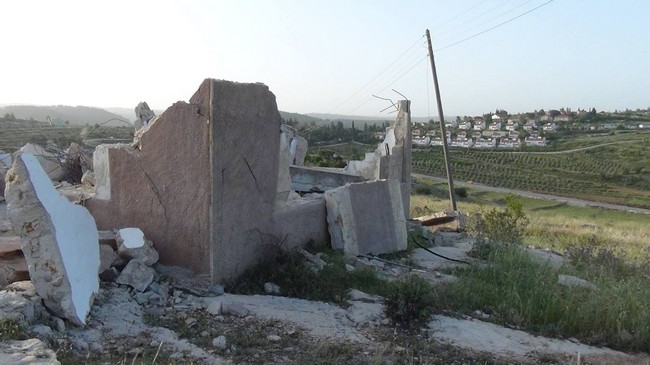
Four years ago, the residents of the village received demolition orders, but they were never carried out. On Monday, bulldozers razed an uninhabited house. Now the villagers, who have been protesting every week since 2009, fear that the army will carry out the rest of the demolition orders to collectively punish them.
“When we started the demonstrations five years ago, we knew we would have a heavy price to pay,” says Manal Tamimi, a resident and activist in the West Bank village of Nabi Saleh, near Ramallah. “Not just with violence and home demolitions, but also with our lives.” She pauses. “But under occupation you lose everything. And when you have faith in what you are doing, you don’t care what will happen to you.”
Nabi Saleh ended up paying a heavy price, many times over. Since 2009, when weekly non-violent demonstrations began to protest the annexation of the village’s well and land by the next-door Halamish settlement, the villagers have been embroiled in ongoing clashes with the Israeli army. Injuries from live ammunition have become a regular feature of the protests, with Manal herself having recently been shot in the leg. Two protesters have been killed over the years, including Mustafa Tamimi who was shot in the face with a tear gas canister at close range. And now, with the arrival of bulldozer at 4 a.m. on Monday, the threat of home demolitions was finally underway.
“Four years ago, the army gave demolition orders for thirteen houses in the village, but they were never carried out,” explains Manal. “At four in the morning on Monday, we suddenly heard the sound of a bulldozer and didn’t know what was going on. They didn’t give any excuse or warning.”
Following the events of Monday night, Nabi Saleh’s residents are now worried that the army will begin carrying out the rest of the demolition orders. The house that the Israeli army demolished was uninhabited, but the remaining orders are for buildings that house families, including children.
“About 20 percent of the village is under threat,” says Bassem Tamimi, another prominent activist in Nabi Saleh. Because the majority of the village’s land falls in Area C of the West Bank, which is fully controlled by Israel, residents are unable to obtain building permits. This, in turn, provides the military with a pretext for issuing demolition orders.
But the residents of Nabi Saleh are convinced that the army’s actions are merely a form of collective punishment. “When they gave the orders four years ago, they told us: ‘If you stop the protests, we will stop the demolition orders’,” says Manal.
There is also a general feeling in Nabi Saleh that with the demolition, they are entering a new period of violence. The last few months have already seen a noticeable escalation in the army and Border Police’s suppression of the weekly demonstrations. In addition to the use of live ammunition in contravention of army regulations, in recent weeks soldiers have also been filmed firing tear gas directly at demonstrators and assaulting photojournalists.
Nonetheless, on Tuesday, residents began rebuilding the home that was destroyed. The army intervened, causing a confrontation with youths who were working on the house, but Manal confirms that the rebuilding will continue until it is complete – in spite of the threat from Israeli security forces. For those in Nabi Saleh, this episode is symbolic of their wider struggle. “The house demolitions are meant to scare us. But we will not stop our resistance,” Manal says. “We have been told before that if we stop our demonstrations, we will get our well back. But we do not want to give up and be weakened; if we do, they will just take another area from us later on.”
“They have to understand that it’s not just about a piece of land. This is about the occupation.”