Uriel Ferera says he doesn’t feel like he lost the 177 days that he spent in military prison. ‘The opposite. I fought for my principles — to not lend a hand to the occupation.’
By Daniel Beller
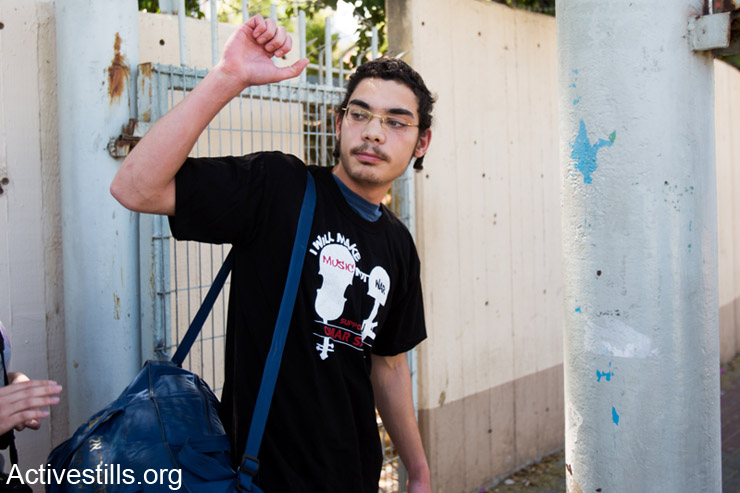
After 177 days in Israeli military prison and 10 trials, ideological conscientious objector Uriel Ferera is a free man. When Ferera arrived at an IDF induction base on Sunday he was under the impression that he would be heading back to jail for an eleventh time. Instead, he was told that the IDF was releasing him from military service for “incompatibility on the basis of grave and bad behavior.”
Ferera says that the army had previously offered for him to see a military psychiatrist in order to justify his release from service on psychiatric grounds. “But the mental health officer, that’s a way for the army to wash its hands [of me]. They don’t want to face the truth. I insisted and was sentenced [to prison] 10 times. In the previous sentencing, the military judge said that it in all likelihood it would be the last time.”
Ferera, of Be’er Sheva, comes from an Orthodox family that immigrated from Argentina. “I wanted to perform national [civilian] service but not in an occupying army. I didn’t want to lend my hand to the occupation and the oppression of another nation,” he said.
The hardest day was his first day in prison, Ferera explained. “They tried to break me, with verbal and physical violence.”
The other prisoners weren’t aware of why Ferera was there, he continued, and they didn’t really care. “In military prison, everyone is on their own. Even when I was put on trial, the judges didn’t always know my background.”
The IDF’s Prison 6 was tough, Ferera explained following his release from the army. “When they saw that I had gotten used to the place, they transferred me to Prison 4.” Ferera was worried about the transfer, he said, because it’s the same prison in which another conscientious objector, Omar Sa’ad, became ill and was hospitalized in serious condition. “But Prison 4 had a less tough atmosphere. They didn’t try and break me there like in Prison 6.”
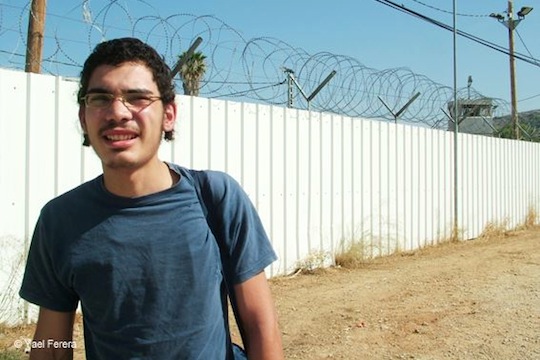
In between prison terms, Uriel became aware of the public support for his struggle. Less so in prison, if at all. “I think that one of the reasons the guards didn’t speak with me about why I was in prison is that they didn’t want’ to confront the truth.”
“It would have been easy to send me to the army psychiatrist. It was harder for them, it seems, to confront what I was actually saying,” he added.
“When I walked out of the induction base I still hadn’t processed that I’m a free man,” Uriel said.
The young conscientious objector says he’s ready to move on with his life — to register for higher education, to volunteer for national civilian service, to continue struggling against the occupation.
“I will volunteer to guide other draft refusers, with organizations like “Yesh Gvul,” he explained. “To accompany them like others accompanied me.” The family of Natan Blanc, another draft refuser who was also sent to prison for upwards of 170 days, supported Ferera’s mother, he said. “They worried that I would be put in prison yet again.”
Looking back at his time in prison, Ferera says that he doesn’t feel like he lost 177 days of his life. “The opposite. I fought for my principles — to not lend a hand to the occupation. The side that lost is the State, which kept me in prison for 177 days.”
It was important for Ferera to not let the army release him on psychological grounds, he explains. “They pushed and they threatened — they tried to break me. But as more and more time went by, I understood that I am strong and that I could survive.”
Uriel Ferera went home on Sunday — this time, it was for good and with his head held high.
This article was first published on +972’s Hebrew-language sister site, Local Call. Read it in Hebrew here.
Related:
‘How speaking out about the occupation nearly landed me in jail’
[WATCH] Druze refusal in the Israeli army (part 1): A history lesson