

When leaders from center-left aren’t willing to deepen the struggle against the occupation, it’s hard not to feel that they, too, prefer the status quo. Notes from the Haaretz Conference for Peace.

The most genuine moments at Thursday’s Haaretz Conference on Peace came from two right-wing speakers — Yariv Levin and Ze’ev Elkin, both ministers in Netanyahu’s government — who unequivocally called the two state-solution a “hallucination,” which they have no plans of ever implementing. Since neither of them have any intention of granting citizenship to Palestinians under occupation, they view the current situation as the solution.
Around the same time Prime Minister Netanyahu tweeted that despite what he may have said during his recent trip to the United States, he has no intention of unilaterally evacuating West Bank settlements:
אין לי שום כוונה לפנות או לעקור יישובים, הטעות הזאת לא תחזור. pic.twitter.com/LHSxIPuFUu
— Benjamin Netanyahu (@netanyahu) November 11, 2015
(Translation: I have no intention of evacuating or uprooting settlements, this mistake will not be repeated)
And just as Netanyahu is not willing on signing an agreement that any sane Palestinian leadership could live with, he also believes that the status quo is the solution — at least in the near future.
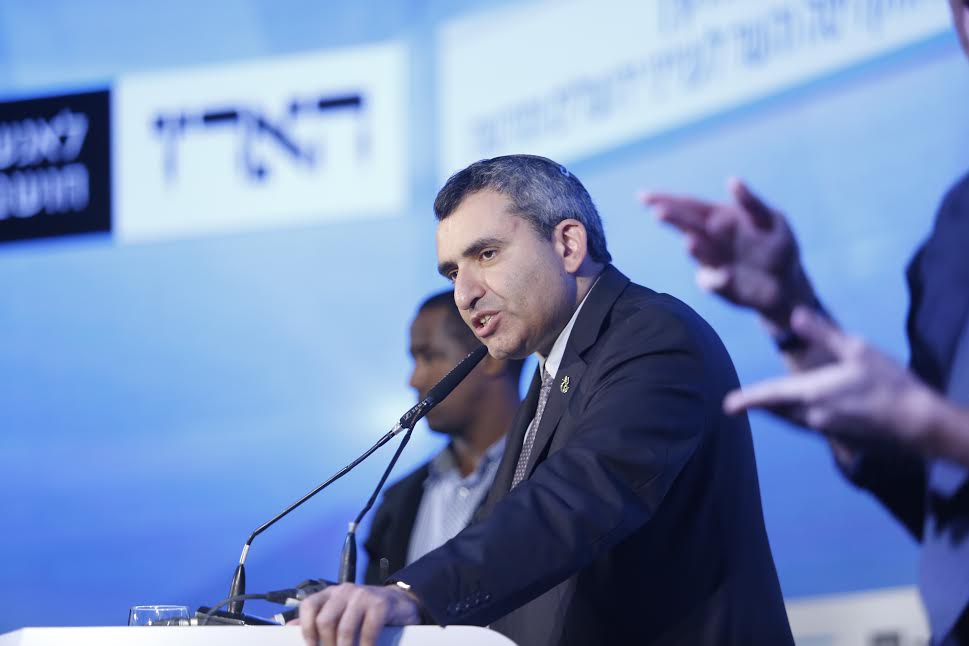
I spent a good part of the day at Haaretz’s conference (I did not stay until the end), and the incredible thing is that these declarations — which did not come from the fringes of the right, but from the Israeli government and its spokespeople — did not seem to make an impression on anyone there. Very few of the speakers or panelists referred to them, and those who did — such as Joint List head Ayman Odeh or Amir Peretz of the Zionist Union — argued with Elkin and Levin, rather than dealing with the significance of their statements. As if Levin and Elkin were two internet trolls who happened upon the conference and decided to disrupt us while we were busy drawing up maps and tried to restart negotiations.
Martin Indyk, who was interviewed onstage by Haaretz Editor-in-Chief Aluf Benn, implored the crowd not to give up hope, saying that the problem between the two sides has been a “lack of trust.” Former British Prime Minister Tony Blair believes that Netanyahu is not interested in maintaining the current situation, and that if we only create the “right conditions,” the Israeli public will support an agreement (Blair’s new ticket is a regional peace initiative, although similar ideas have been on the table since 2002. In any case it doesn’t seem like the Israelis were all that impressed). Peretz presented his own political plan, as if he is about to represent Israel in peace talks with Palestinians. The rest of the speakers, both Israelis and foreigners, all spoke of trust, peace, hope — as if we were at a conference for mystics or poets, rather than a political forum.
Did the crowd simply not take Elkin, Levin, or Netanyahu seriously? Or perhaps they just didn’t hear them? If they had, the only relevant question is what steps are we we willing to take to end the occupation. What is everyone willing to do within their sphere of influence. What does she support, what does he oppose.
The Labor Party doesn’t need to present its own peace plan — we have enough of those. Instead it needs to present a plan for the opposition. For example, do none of the leaders of Labor believe that labeling settlement products is a legitimate step? Are any of them willing to speak to Hamas?
I may be complaining about those who spoke at the conference, but among the leaders of the center-left — Tzipi Livni, Isaac Herzog, Yair Lapid, or all the security-oriented backbenchers who did not come speak — the situation is far worse. Do Herzog and Lapid really need to keep competing over who is the better Netanyahu spokesperson.
No one is willing to take the chance. No one is willing to waste their political capital, as if whatever is left of it will help them win the next election (it won’t). And if no Israeli politician from the center-left is willing to take the chance and deepen the struggle against the occupation, maybe what they are telling us, that the occupation is the biggest threat to Israel’s existence, is simply untrue? After all, when it comes to existential threats, shouldn’t all the calculations go out the window? Perhaps they think that we can continue living with the status quo? And if so, how are they any better than Netanyahu?
Last year I praised Haaretz [Hebrew link] for including people who still insisted on speaking about peace and hope, and that’s important. But “let’s not lose hope” is not the appropriate message for a political conference. These days, the gap between the Israeli Left’s warnings on the coming catastrophe and its lack of political commitment is far more frustrating than the Right’s declarations.
This article was first published in Hebrew on Local Call. Read it here.