
India’s Prime Minister Narendra Modi’s first official visit to Israel comes at a time of both rising economic cooperation growing nationalism in both countries.
By Inbal Ben Yehuda
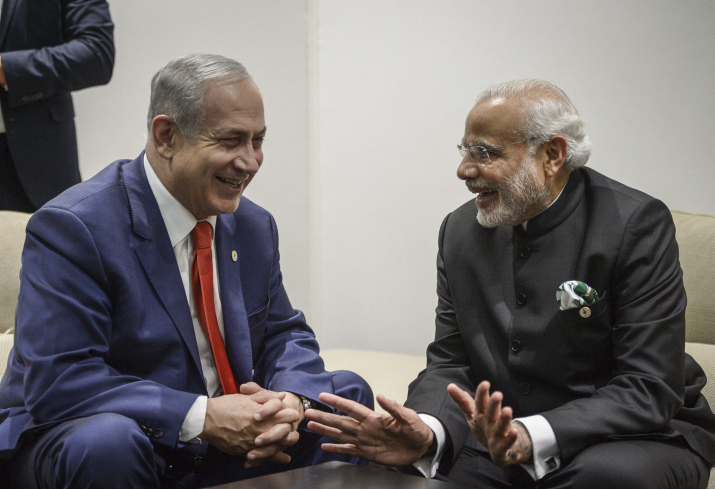
Indian Prime Minister Narendra Modi arrived for a three-day visit in Israel on Tuesday. Alongside meetings with government officials, Modi will travel across the country and will meet with leading Israeli and Indian businesspeople. In addition, Israel’s Indian community will host the prime minister for a festive event, which will include Israeli Jews of Indian origin. This is the first time India’s prime minister has ever visited Israel, marking 25 years since the two countries formally established diplomatic ties, which began in 1992.
Although India formally recognized the State of Israel in 1950, it took another 42 years until it established diplomatic relations with the Jewish state, due to its historic support for the Palestinian cause. Over the years, India attempted to create a balance between its ties with Israel and the Palestinians, although it seems that the current visit symbolizes a change in this tendency.
As opposed to other Indian leaders who visited the region, Modi will not meet with officials from the Palestinian Authority. In order to keep some semblance of balance, Palestinian President Mahmoud Abbas was invited to India this past May for a four-day visit. In the run-up to that visit, India’s foreign minister emphasized the close historic ties between India and Palestine, and said that “apart from our political support for the Palestinian cause, India continues to support development plans in Palestine by extending technical and financial assistance.”
On the other hand, diplomats and media outlets have pointed out that New Delhi has shed its hesitation in acknowledging deepening ties with Jerusalem, and that Modi’s diplomacy vis-a-vis the Palestinians pales in comparison to his current visit to Israel. According to Asaduddin Owaisi, a member of India’s federal parliament from a regional group that promotes Muslim rights, “Narendra Modi’s visit to Israel will only strengthen its occupation of Palestine.”
Arms deals and hypernationalism
The intensive preparations for Modi’s arrival were a testament to the fact that Modi’s visit is the most important this year following that of President Trump. So important, in fact, that Modi will be staying in a luxury suite in Jerusalem’s King David Hotel, the same one Trump stayed in during his visit. Modi’s reception, which has been in the planning for months, will be accompanied by much pomp and circumstance. A red carpet will be rolled out in his honor, and among his greeters will be Michael (Mikey) Federmann, the head of the Dan Hotels group, which owns the King David Hotel.
Federmann is also the chairman of Elbit System, an Israel-based arms and aerospace manufacturer, which has signed major deals with the Indian government. Thus Elbit in now part of a group of Israeli arms exporters that have a role in Modi’s plan to modernize the Indian Army. The plan, which has included over $100 billion of investments on the part of both Russia and the United States, is meant to strengthen India’s abilities and positioning vis-a-vis Pakistan and China.
Among the stated goals of Modi’s visit is strengthening and promoting the existing cooperation between the two states, with an emphasis on Israeli technological exports that will assist the Indians in water infrastructure, agriculture, and space exploration, as well as expanding economic, scientific, and academic cooperation. Above all, however, much of the agreements that have been signed between the two countries over the past few years, and especially in the last months, largely deal with security. India is the largest market for Israel’s security industry, with the former purchasing weapons and technology to the tune of an average $1 billion a year.
India’s status as a rising world power makes it an important partner for Israel to strengthen its economy, while at the same time Israel invests in India and hopes to continue benefitting from the ongoing cooperation between the two countries. But it seems that more than ever, Modi’s nationalist and right-wing ideology has bolstered India as a decisive factor on the diplomatic stage in the eyes of Israel — a place where the Jewish state is no longer so popular with the West. Modi’s attitude toward the Muslim population of India, the largest religious minority in the country, certainly fits with the guiding principles of Israel’s right-wing government.
Inbal Ben Yehuda is a blogger for Local Call and a research fellow at the Forum for Regional Thinking.This post was originally published in Hebrew on Local Call.