Hassin Mohammed Hassin Abu Gosh, 17, stabbed an Israeli woman to death and was killed in the act. Last week, in retaliation, Israel demolished his home in the Qalandia refugee camp. The ruins are a silent testament to a once thriving life.
Text and photos by Tamar Fleishman
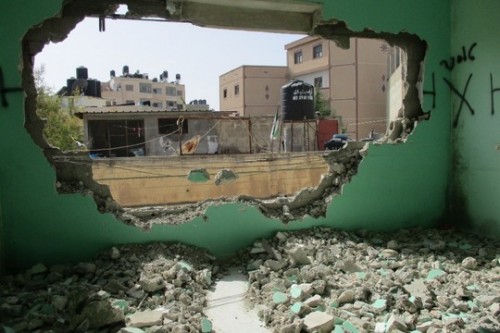
A demolished home is a testament to a once thriving life.
Last week, a large IDF contingent entered the Qalandia refugee camp in the West Bank and demolished the home of Hassin Mohammed Hassin Abu Gosh, a 17-year-old Palestinian who was killed in January after stabbing a settler to death.
The demolition of their third-floor apartment, on the night of April 20, went on for three hours, during which their downstairs and next-door neighbors listened with dread to the sounds of walls being shattered and household appliances smashed.
When the sun rose, it shone on the empty, dilapidated third floor that stood out like a severed limb of an otherwise functioning body.
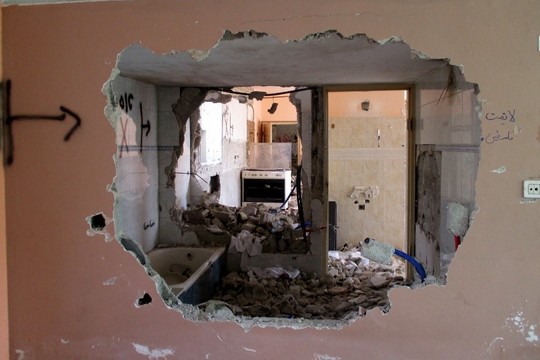
Nine people lived there: two adults, four girls and three boys. It wasn’t hard to guess, according to the colors of the walls, which rooms were the boys’ and which the girls’.
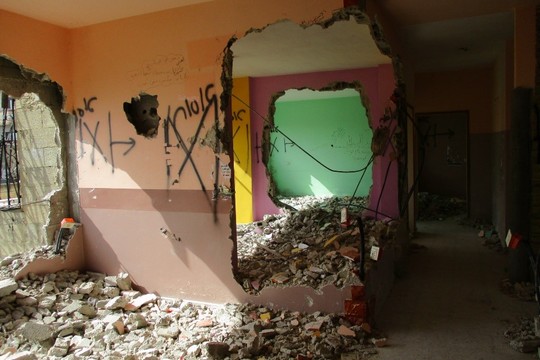
The rooms were bereft of life, of content, of a homey ambiance.
The walls were decorated not with paintings, but with ugly black inscriptions, probably written by the troops as instructions to their comrades.
Between the broken pieces, between the nothingness and the lifelessness, through the shattered walls, one’s eyes are focused on a stove that stands in the middle of what used to be the kitchen.
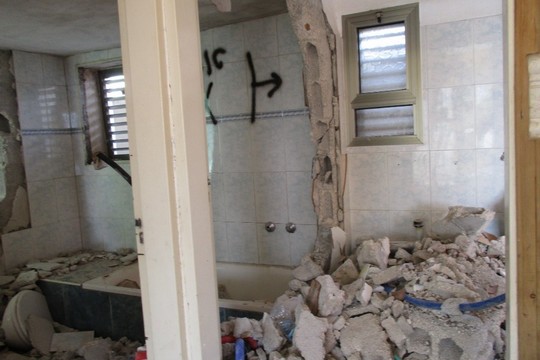
Like a character in the theater of the absurd, the stove stands in the middle of the scene, unscathed.
And life around the house goes on, because that’s what life does – go on. New laundry has been put out to dry in the floor below, and across the street people pass by, look up, and nod their heads in despair.
The front door through which one is invited into the scene barely hangs on its hinges. It was locked by a member of the family who shoved the key deep into its pocket, holding on to it like the only remnant of a life that once was. The key to the house, as generations of Palestinian refugees have learned, is sometimes the only remaining witness.
On the backdoor, two posters of martyrs are billed. One is of Hassin Mohammed Hassin Abu Gosh, and the other of Ahmad Abu al ‘Aish, who was killed by IDF fire six months ago, while protesting against a house demolition nearby.
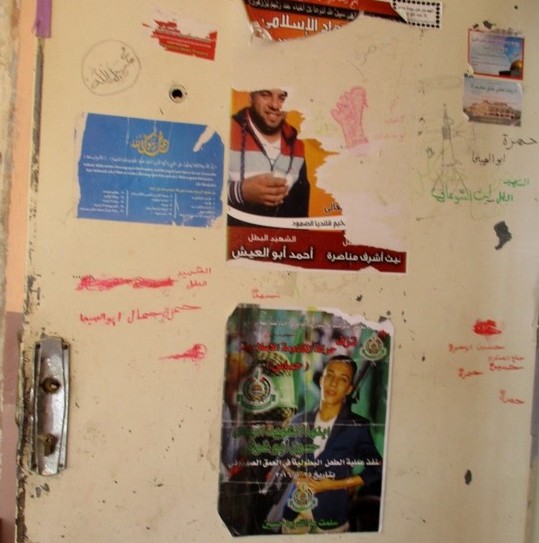
The house was demolished “in keeping with the government’s decisions,” the IDF said. But why?
Can these be seen as a just punishment at all? The criminal is no longer alive, so his family is being punished for something they didn’t do. Can anyone call this justice?
There’s no deterrence in it either, and this is something that both Israeli security experts and residents of the refugee camp say.
The only justification is the need for an image of enforcement. The IDF needs to show that it can and will do “justice” to those who engage in violence.
But its interlocutor isn’t the Palestinians; they are aware of the “justice” the IDF can and does. The IDF hopes that this message will not fall of deaf Israeli ears.
Tamar Flesichman is a photographer and anti-occupation activist. This article was first published in Hebrew on Local Call. Read it here.