
As Israelis debate whether an Israeli soldier should or shouldn’t have killed an incapacitated Palestinian, it becomes clear that we know close to nothing about the victims of the occupation.
By Orit Kamir
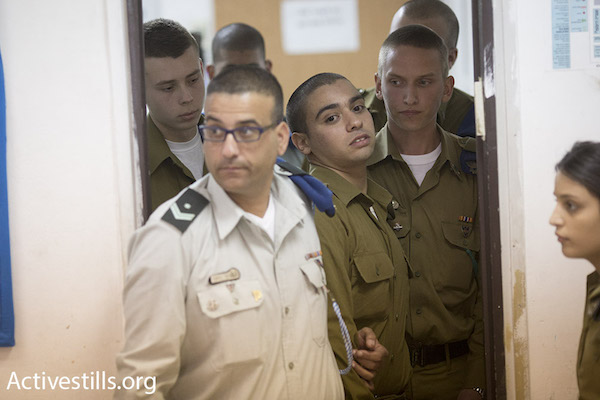
Elor Azaria is an Israeli soldier, a paramedic, who shot and killed a Palestinian civilian that had previously tried to stab Israeli soldiers in Hebron. Azaria shot the Palestinian in the head when the man was lying on the ground, at Azaria’s feet, helpless and defenseless. Since the event was photographed and publicized, Elor Azaria has been put on trial for manslaughter. His trial is the talk of the town and the country is up in arms over it. Many Israelis — including leading politicians and government members — support Azaria and consider him a hero. Prime Minister Netanyahu called his parents to express his support and sympathy. Israeli media and public discourse never tire of scrutinizing every little detail related to him. Yet no one seems to remember his victim, the young man whose life he took: Abdel Fatah al-Sharif.
Having read media coverage of Azaria’s ADHD, it suddenly hit me that I knew nothing, not a single thing, of his victim; the person whose killing seems to be shaking Israeli society to its core. I know not where he lived, what his life was like, what caused him to go out on his suicide mission. I have no idea what his face looked like; what his eyes conveyed: no one bothered to supply me with his photo. A lengthy search on the internet revealed little: al-Sharif was 21 years old when he died. His body was returned by Israel to his family, and his funeral gave rise to anti-Israeli sentiment. That’s it. That’s all I could find. Apparently, that’s all we, Israelis, want to know about the victim of the killing that supposedly has us exasperated.
Was al-Sharif enraged by the killing of a family member at the hands of Israeli soldiers? Had he lost his job? Did he seek a hero’s death, as did other young Palestinians? Was he influenced by religious ideology? It seems that we, Israelis, couldn’t care less who Abdel Fatah al-Sharif was, and what drove him. To my astonishment, not a single journalist has taken the time to look into these questions, attempting to provide us with even the bare minimum information. We — the public and its media — are busy trying to understand the soldier who shot al-Sharif, his family members, his supporters, the politicians who incited him — everyone but his victim.
The total silence surrounding Abdel Fatah al-Sharif makes clear exactly what has us up in arms. It isn’t the fact that his blood was shed, or that his young life was taken unnecessarily. We are upset about our soldiers opening fire against regulations; about discipline and obedience to army commands; about our international prestige; about political-moral issues such as whether every Palestinian who holds a knife automatically loses his right to live. But Abdel Fatah al-Sharif himself does not interest us, and his death does not affect us. For us he is simply a “terrorist.” As if that title deprives him of his humanity. As if once a “terrorist” — he is no longer Abdel Fatah al-Sharif, a victim of an unnecessary killing; a fellow human deserving of our interest and care.
Abdel Fatah al-Sharif was not a “terrorist”: he did not attack innocent civilians, but rather armed soldiers on occupied territory. Yet we are blind to such “fine distinctions.” To us he was merely a “terrorist” — no one worth thinking or worry about.
The most powerful contemporary slogan in the United States is “Black Lives Matter.” Its purpose is to remind us that while, in fact, the lives of black people do not matter, blacks do have human dignity and deserve full human rights. It is time that we adopt this slogan in Israel and declare, once and for all, that Arab lives matter.
Dr. Orit Kamir is the head of the Israeli Center for Human Dignity. A version of this article was first published in Hebrew on Local Call. Read it here.