By Hagai El-Ad
Israel’s ambassador to Washington, Michael Oren, tries hard to separate the Israeli social justice protests from the Arab Spring. He ends up sounding both out of date and out of touch.
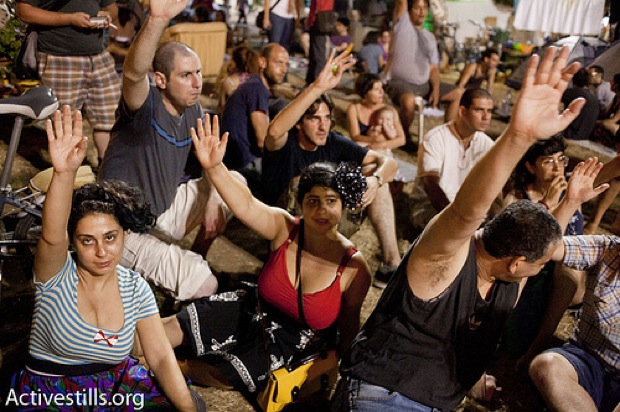
Israelis and Palestinians are again gradually engulfed in escalating violence. While hoping that the situation will not further escalate, Israel’s social justice protests are faced with the challenge of not evaporating in the face of security challenges. Business is not as usual – and no one is pretending that it is. And yet, nor were the social justice protests an expression of “business as usual”. So, there is now a spirit in Israel of staying course on social justice demands – while withstanding the agony of rockets and bombs, and the rising civilian toll in Israel’s south and in Gaza. In that spirit, I wish to respond to a recent piece by Michael Oren, Israel’s ambassador to the United States.
Oren, in his August 15, 2011 USA Today piece, “Israeli Summer is no Arab Spring,” strived tirelessly to draw a clear line in the sand between the-only-democracy-in-the-Middle-East cliché and its neighbors. Oren states that “far more than a single season separates the Arab Spring from the Israeli Summer,” but how many layers of blind cynicism separate the ambassador’s words from Tel Aviv?
Oren’s first faux pas is his bearings. His vaguely hidden efforts to distinguish Israel from Arab countries are completely misaligned with the energy emanating from Israel’s streets this summer. The iconic stage background image at the first major social justice demonstration in Tel Aviv, on July 23, was of Tahrir Square, with the headline in Hebrew: “This is the beginning of a social revolution.” Unlike in Oren’s piece, in Tel Aviv there was no attempt to keep a distance from the courageous people of Egypt – on the contrary, Tahrir was unabashedly celebrated as a source of inspiration. Further, the unapologetic revolutionary vocabulary in Tel Aviv was a far cry from Oren’s confident – though baseless – “knowledge” of how truly far reaching are the changes sought by the people in Israel.
If Oren would have only bothered to listen, he would not have missed the chants of what “the people demand.” the same slogan heard in Cairo and many other Arab cities – and which has also reached many Israeli cities. Same tone, same rhythm, same people power. In Israel, it was initially only articulated in Hebrew, but has gradually also been heard in Arabic, now sometimes mixing the two official languages of this country in expressing what “the people demand.” How could Oren not hear that the people are not interested in his old school arrogance?
Then, there are all those cynical attempts to deceive, which made me move uneasily while reading. Where to begin? Oren is shameless in celebrating the unity between all segments of Israeli society as expressed in the current wave of protests in Israel, while “many of the Arab rebellions have pitted rival religious and ethnic groups against one another.” But is he not the ambassador of an Israeli government that has done perhaps more than any before it to pit Jews against Arabs in Israel, a government that has consistently aimed to portray Arab citizens as an always suspect fifth column, a government that has mainstreamed racist positions and advanced discriminatory legislation?
Oren concludes his masterpiece with a solid punch to freedom of speech: “We hope that someday soon, our neighbors will enjoy those same basic rights.” We hope?! One of course should not question the ambassador’s sincerity. Perhaps, then, he is simply ill informed, unaware of the fact that the reason “our neighbors” the Palestinians do not enjoy the “same basic rights” and cannot exercise freedom of speech has something to do with military orders issued by the military commander of the occupied Palestinian territories? There is no need to rely on hope alone; the military commander simply needs to begin respecting “those same basic rights.”
Unlike many confident Israeli “experts,” I do not know where the Arab Spring will lead. I do know that the experts’ doomsday predictions and prophecy that “Arabs cannot do democracy” have thus far not come to be. I wish the people in neighboring countries nothing but the fulfillment of their just aspirations, and I am constantly inspired by their courage.
Unlike Oren, I do not know where this hopeful summer will take Israel. Withstanding Oren and the government he represents, I remain optimistic. I do hope that the future will bring not only social justice, but also that those who represent this country will do so with integrity and will abandon zero-sum attitudes – attitudes designed to embarrass others, but that only end up shaming us.
Hagai El-Ad is the Executive Director of the Association for Civil Rights in Israel