

By comparing the deteriorating security situation along Israel’s northern border with security arrangements in any future Palestinian peace deal, was Netanyahu making declarations to thwart the success of Kerry’s planned peace talks?
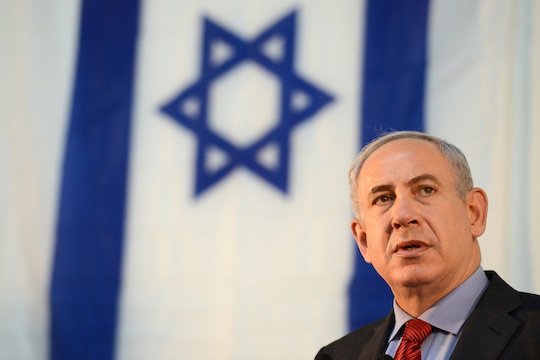
Prime Minister Netanyahu said a few interesting (and politically genius) things at the weekly cabinet meeting Sunday. Various media outlets construed his statement in different ways, which was apparent in the different headlines with which they led.
Many English-language news sites chose some variation of the headline: “Israel won’t intervene in Syria unless fired upon.” The Times of Israel, however, led with, “Netanyahu alludes to military action at Syrian border,” which is almost the reverse meaning but remains logical nonetheless, since Netanyahu was referring to the vaccum left by waning UN forces on the Golan.
Other local Jewish Israeli sites — in Hebrew and English — led with variations of: “Netanyahu says Israel can’t depend on international forces for its security” Haaretz added to its headline the clause: in any future peace agreement with the Palestinians. Of course all these headlines are connected and related. Most important is the connection Netanyahu makes between the tensions on the Syrian border and a negotiated solution with the Palestinians.
Let’s look at what Netanyahu actually said. (from the PMO’s website):
Israel is not intervening in the Syrian civil war, as long as fire is not being directed at us. The crumbling of the UN force on the Golan Heights underscores the fact that Israel cannot depend on international forces for its security. They can be part of the arrangements. They cannot be the basic foundation of Israel’s security.
I will also discuss this with U.S. Secretary of State Kerry. I have spoken, and will speak, with him about this, and together we will try to advance a way to find an opening for negotiations with the Palestinians with the goal of reaching an agreement. This agreement will be based on a demilitarized Palestinian state that recognizes the Jewish state, and on solid security arrangements based on the IDF.
Netanyahu managed to transition smoothly from saying Israel will not intervene in Syria unless attacked, to stating (read: deducing) that any deal with the Palestinians must happen on Israel’s terms because the UN peacekeeping force is crumbling and unreliable.
That may certainly be the case, and no country can be expected to willfully turn its security over to a foreign entity. However, the direct correlation between the very real implications for Israel from the Syrian civil war and the fact that no agreement with the Palestinians can be based on international security forces, sounds awfully like a reference to Samantha Power’s statements from 2002, circulated last week following her nomination to be the next U.S. ambassador to the UN. In it, she discusses imposing a solution to the Israeli-Palestinian conflict through “external intervention” and backed by a “meaningful military presence,” which of course made a lot of noise in Republican and “pro-Israel” media circles.
She has since distanced herself from these statements (she has to if she wants to avoid the “pro-Israel’ onslaught) and was subsequently endorsed by key pro-Israel figures like Alan Dershowitz.
Looking at Netanyahu’s words in the cabinet today, it seems he was directly addressing Kerry, via Obama and his Power appointment, drawing a comparison between the violence in Syria and its impact on Israel with his conditions for negotiations with the Palestinians. The two issues are entirely separate, of course. And therein lies his political savviness.
He used the chaos in Syria in order to reaffirm Israel’s preconditions and unilateral approach to negotiations with the Palestinians. In the process, by comparing the two, he sent a message that Israel cannot trust any Arab state or international entity. In other words, he reiterated that Israel will only trust itself when it comes to security.
While that may be true, and while no country can be expected to put all of its security in foreign hands, it does not justify establishing unilateral and unbalanced preconditions for an agreement with Palestinians (i.e. demilitarization). Especially when Israel is unwilling to make the most basic move: ceasing to build on territory designated for a viable Palestinian state.


