

The Israeli government has been quietly authorizing illegal settlement outposts in recent years. A criminal activity, the trend also exposes Palestinians to increased violence and harassment from settlers.
Text by Rachel Shenhav-Goldberg
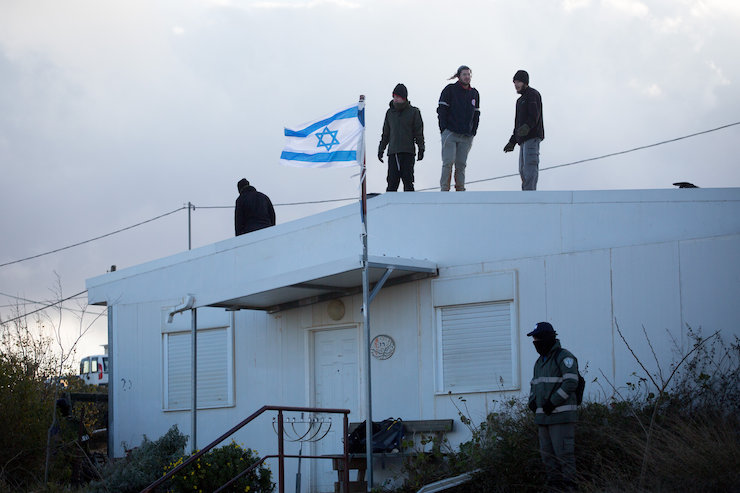
Illegal settlement outposts have become increasingly regularized during Prime Minister Benjamin Netanyahu’s tenure, according to a recent report from Israeli settlement watchdog Peace Now. In a trend largely kept hidden from the Israeli public, these unauthorized outposts enjoy unwavering support from the government, despite their clear illegality. According to the report, 15 such outposts have already been legalized, with at least 35 more on the way to authorization.
The goal is permanency; the strategy is “facts on the ground.” Starting out as ostensibly temporary settlements, courts find themselves unable to enforce demolition due to outpost leaders’ clever legal tactics.
One such method involves settlers using various code words and phrases in official correspondence: “The preservation of state lands” means the removal of Palestinian presence from the area, for example. Another strategy sees outpost leaders using trucks on wheels for housing rather than buildings, as vehicles do not require building permits. In this way, the outposts evade court demolition orders.
In recent years, settlement organizations have employed a new method of rapidly expropriating large swaths of Palestinian land with little investment, by setting up agricultural farms. As the report explains, initial takeovers of land for outposts are often carried out by a handful of people, perhaps a couple of families with children, who take over stretches of land for “land cultivation” or grazing.
To the naked eye, these farms look like individual, local initiatives, and because outposts are illegal, it is difficult to establish “who is behind their establishment, where the money originates, and what portion have the various authorities contributed to them.” Yet Peace Now’s research shows that these outposts are an organized and well-funded project backed by non-governmental bodies such as the Amana movement, a private organization promoting Jewish settlement on occupied lands, and the Settlement Division of the World Zionist Organization.
The report emphasizes that the most significant assistance comes from the government itself, which sends a clear message to the settlers: “You may establish facts on the ground illegally, and we will expunge your crimes.” Most of the time, the Israeli authorities remain passive and simply refuse to enforce the law, thereby turning a blind eye to the everyday acts of official bodies.
This attempt to create geographically contiguous settlements has direct effects on the Palestinians. Settlers frequently act as self-appointed “wardens,” expelling Palestinians from their their home villages. Palestinians who remain are often subjected to intimidation in the form of “threats, harassment, theft and even violence by settlers,” according to the report.
Conflicts do not last forever. It is likely that in the future, a peace agreement will involve the evacuation of Israeli settlements — a price that will likely be paid by the settlers themselves, who will have to endure the trauma of leaving their illegally-seized homes. This was the story of Yamit in the Sinai in 1982, then Gush Katif in the Gaza Strip in 2005, whose settlers were evacuated by Israeli authorities.
Rachel Shenhav-Goldberg is an Israeli living in North America. She has a PhD in social work from Tel Aviv University and a post-doctorate from the University of Toronto. Her research focuses on anti-racism in Israel and anti-Semitism in North America. She is also a group facilitator, practices social work, and volunteers with the New Israel Fund in Canada.