Vote comes amid greatest economic crisis in three decades, and represents a shift to the political right
LISBON – They say: if it ain’t broke, don’t fix it. But if it IS broke, fix it. And fix it fast. One of the fundamental ideas behind democracy is that if the government is doing a bad job, the voters can – and will – give it the boot. On Sunday, the Portuguese people did just that. They went to the ballot box and voted for “mudar,” or change, as promised to them by the party of Prime Minister-elect Pedro Passos Coelho. His center-right Party of Social Democrats, or PSD, received twelve percentage points more than the Party of Socialists, or PS, of now-former Prime Minister Jose Socrates. It was not enough to give the PSD a clear majority – it will have to form a coalition with the rightwing CDS. But it was enough to send a clear message to the left: it’s been broken, and you didn’t fix it … now go home.[youtube]http://www.youtube.com/watch?v=abPVY3lgPHU[/youtube]
It’s not entirely fair to blame the PS and Jose Socrates for Portugal’s economic woes. In truth, things started going downhill many years ago, shortly following Portugul’s economic haydeys in the 1990s when it hosted the world expo in Lisbon. Socrates became prime minister in 2005. He was preceded by leaders from the PSD, among them Jose Manuel Durao Barroso. Time to connect the dots: this is the same Barroso who currently sits as the president of the European Commission, the executive body of the European Union … which just approved $112 billion dollars in conditional aid to Portugal, money that will now be managed by the PSD (the party Barroso formerly led).
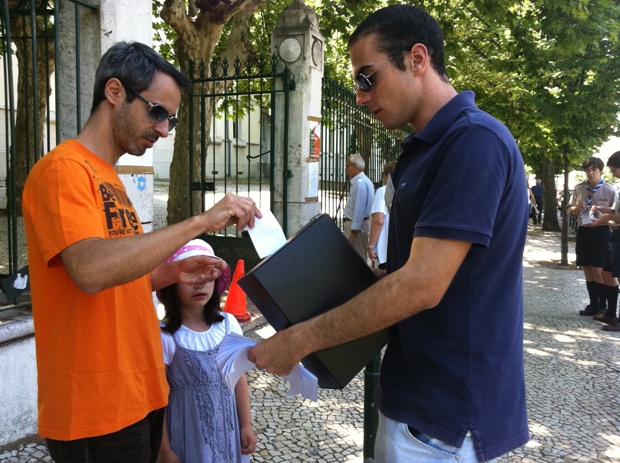
I’m not a conspiracy theorist by nature, but it is easy to understand why some people found the cycle suspicious, and found the election to be a farce. One day before the vote, a group calling itself “Democracy Right Now” was removed – by force – from Lisbon’s Rossio Square, after fifteen days of consecutive camping-out. The group says Portugal’s economic sovereignty has been violated, and that leaders in Portugal are effectively puppets of the European Union. Some went even further. One referred to the Portuguese vote as “a regional election” (as opposed to a national one). Another suggested the vote was as much a referendum on the Prime Minister of Portugal as it was a referendum on the Prime Minister of Germany (a reference to Angela Merkel’s dominant presence in the Europe Union). It should theoretically help Portugal that its new Prime Minister is from a party that is political aligned with Merkel’s.
Shortly after losing, an emotional Jose Socrates stood before supporters and did what was expected of him: resigned as head of his party. The move gives more junior PS members an opportunity to reignite a party which now morphs into the opposition, an arguably less attractive but much more comfortable seat. It’s unclear if the PS’s new policies will be any different than their old policies. But they will now have the advantage of being able to play “good cop,” while PSD struggles to play “bad copy.”
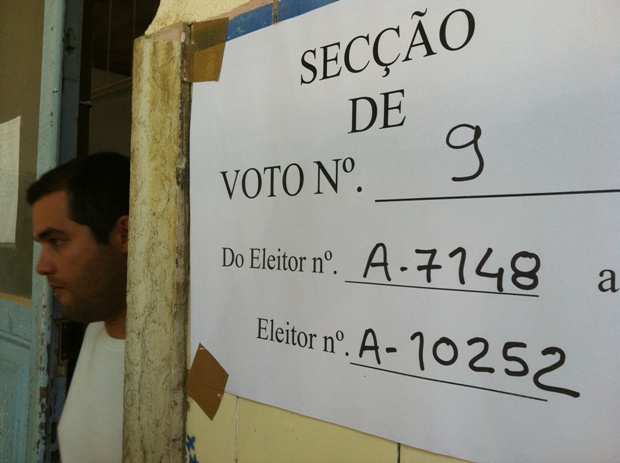
And indeed, after the enthusiasm dies down, the hard work has to begin. Passos Coelho knows that, his party knows that, and his supporters know that. If he fails to deliver on the change he promised, voters will likely send him packing in the next election, and effectively invite back to government the lady-in-waiting Party of Socialists. Again, one of the foundations of democracy is the ability to evict one government and replace it with another. But there’s clearly only so many times one can swap X for Y and Y for X without feeling the urge to just get rid of the whole alphabet and bring in a new one.


