
Hunger striking prisoner Bilal Diab collapsed during a High Court of Justice hearing. The Prison Service disregarded a judicial order to let MK Ahmad Tibi treat him.
Bilal Diab, an administrative detainee on the 66th day of his hunger strike, collapsed today (Thursday) during a hearing in his case in the High Court of Justice. Despite his failing health, the High Court has yet to rule on his case, and while it may still rule today, it is likely the ruling will be postponed to Sunday.
As Diab was removed from the courtroom, Supreme Court Justice Elyakim Rubinstein said “there is a doctor in the room – MK Ahmad Tibi,” and asked Tibi to check on Diab. However, as Tibi noted in a phone interview, as he went to see Diab, followed by an officer of the Court Guard, Prison Service guards refused him access to the patient. When the Court Guard officer told them Tibi was following a judicial order, the Prison Service officer informed Tibi that he “does not take orders from judges.”
Tibi returned to the courtroom, Rubinstein reiterated his decision, and still the Prison Service officer refused to comply. Finally, Tibi returned to the courtroom a third time, and all three justices signed an order demanding he see the prisoner. The Prison Service guards reluctantly obeyed.
Tibi described Diab’s condition as “very bad.” Physicians for Human Rights – Israel (PHR-I) told me in a phone interview that while Diab is being treated in a hospital, three of his limbs are chained to his bed. Another prisoner on a hunger strike, Thaer Halahleh, is being held in the Prison Service’s own medical facility, which lacks the necessary equipment to deal with hunger strikers. They reported that according to Diab, when he was moved to the hospital, a doctor – which the prisoner could not identify – removed him from his wheelchair, put him on the floor, and told him, “You stay here.”
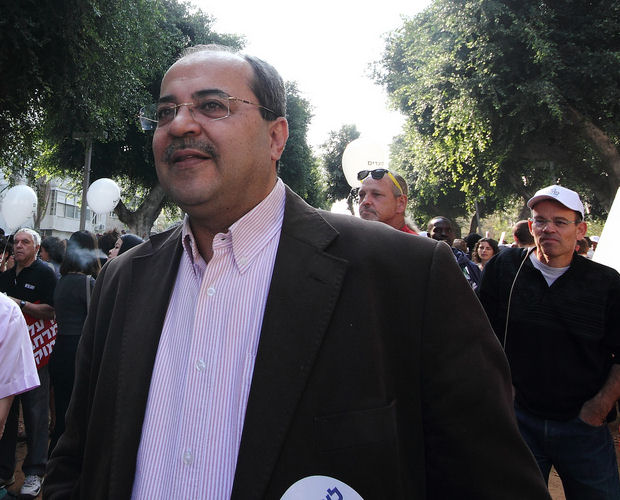
Both PHR-I and MK Tibi note a clear hardening in the attitude of the Prison Service following the hunger strike by Khader Adnan, whose strike ended in a deal that saw him recently released. Both note that while they had relatively free access to Adnan, they have very limited access to the prisoners currently on hunger strikes.
Tibi, again, is an MK; technically, his parliamentary status grants him access to all but the most secure military facilities. Yet this privilege is being disregarded. Tibi thinks this is a deliberate policy of the Prison Service, which is afraid that Adnan’s successful strike may encourage others, and is meant to show that the Service will not back down. He believes this may lead to death of some of the prisoners – which, in turn, will cause an explosion in the West Bank.
Yet despite the behavior of the Prison Service, one cannot escape the feeling that the real cruelty is in the inaction of the judges. Diab is on the 66th day of a hunger strike, everyone agrees he is in very bad condition and may die at any moment – and, according to PHR-I, will definitely die if he passes the 70 day-threshold. Even so, the court takes its time making its decision. The lives of Palestinians are, apparently, less important.


