

On both sides of the Atlantic, the consensus on the need to avoid and resolve confrontations with Israel at all costs guarantees that diplomacy will not change the trends on the ground in the foreseeable future.
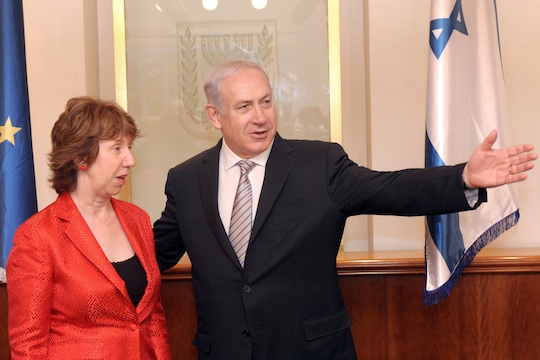
There are more and more signs that Israel and the EU are about to resolve the mini-crisis created by the publication of a commission notice that would have limited EU loans to Israeli entities that operate beyond the Green Line and set stricter rules regarding the use of EU grants and prizes.
Some initial media reports (including on this site) were not accurate in explaining the nature of the guidelines. The commission notice, I was told, was never meant to make Israeli institutions that receive EU funding cease their operations beyond the Green Line. Europe’s effort to mend relations with Israel’s right-wing government, however, is telling: If Europe wanted to send a warning against the settlements and in favor of the two-state solution, the “business-as-usual” messages from Brussels are having the exact opposite effect, demonstrating that the Right was correct all along in declaring that the world would not confront Israel over the occupation.
Indeed, when you separate rhetoric from the realm of actions, the international community seems to be rather supportive of the occupation and indifferent – at best – to the colonization of occupied land.
The most obvious example is the United States, whose cooperation is vital for Israeli control over the West Bank at each and every level. The U.S. provides Jerusalem with the necessary diplomatic cover for the settlements by vetoing Security Council resolutions on the matter, even when they are drafted in the administration’s own words. It uses its influence in other international institutions to shield Israel and Israeli officials from legal actions against them. It provides Israel with the weapons used in the West Bank – the tear gas fired on unarmed protesters is made in Pennsylvania – and it even hands Jerusalem the funds to buy those weapons and ammunition. Washington also supports the PA, which operates as an Israeli sub-contractor in the West Bank and to a certain extent, in Gaza.
In short, don’t be fooled by the State Department’s rhetoric: the U.S. is the enabler of the occupation. One could actually wonder whether Israel carries out its own independent policy with regards to the Palestinians, or if it just operates as a client state with a few independent ambitions.
The European Union is not that different. While policy might occasionally vary on the state level, the EU — as a body whose influence is beyond dispute (it is Israel’s largest trade partner) — has spent the last decade working to secure stronger ties with Jerusalem, regardless of Israeli actions on the Palestinian issue. Whenever those ties come into conflict with the EU’s stated policy about the West Bank and Gaza, relations with Israel win.
Israel has become one of the EU’s most important peripheral states, and it enjoys special relations with the Union on almost every level, from science to economics to football. On all levels, EU officials do their best to shield Israeli entities from anti-occupation activism, from boycott calls and sanctions and from every other mechanism of accountability for the human right abuses taking place in the West Bank. And just like the U.S., the European Union is picking up the bill of the occupation in the form of its support of the PA, canceling out even the modest internal political pressure that could have resulted from the cost of the occupation.
There are internal, domestic reasons that contribute to the European-American support for the occupation. In the U.S. it’s local politics, which are influenced by a strong pro-Israel lobby, Islamophobic national sentiments and view of Israel as part of the larger American empire. In Europe, the Union is able to produce a coherent foreign policy only on economic issues and less so on human rights or security – an imbalance which works in Jerusalem’s favor. Other forces are at play, too, but the bottom line is a consensus view, by political players on both sides of the Atlantic, that seeks to avoid confrontation with Israel at any cost.
Local actors who wish to see change on the ground should recognize this reality. Diplomatic pressure from the outside is not likely to lead to the creation of a viable Palestinian state, mainly because nobody is willing to pay a political price or change policies in order to reach that goal. In fact, European-American influence works more in favor of the occupation than against it.
Europe and the U.S. will continue to try and contain the effect of the Palestinian issue, while setting certain boundaries on human rights abuses, armed operations and Israel’s colonization of the Palestinian territories, as they have done since the 2005 Gaza disengagement. Only a major shift on the ground, like the collapse of the PA or another Palestinian revolt, is likely to change those trends.
Israeli progressives should abandon the hope for change coming from outside, at least on a diplomatic level, and recognize the single-state reality on the ground. Palestinians could question the role the PA is playing and the future of the state-building project under those circumstances.