
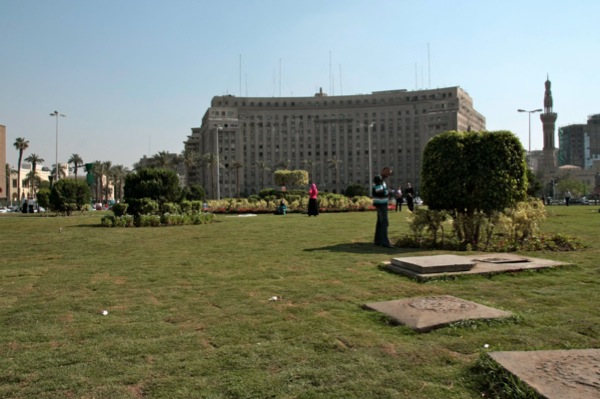
CAIRO — Tahrir Square has been cleaned up. One day last week soldiers laid new turf in the central traffic island, and the next day they planted flowers. A day after that they erected a huge banner that confirmed the army’s commitment to the people and the goals of the revolution, but when I returned two days later with my camera, the banner had already been removed. Instead, I saw young girls photographing each other as they posed in front of the flowers, seemingly oblivious to the roaring traffic as they enjoyed a bit of green in a city that has so little of it.
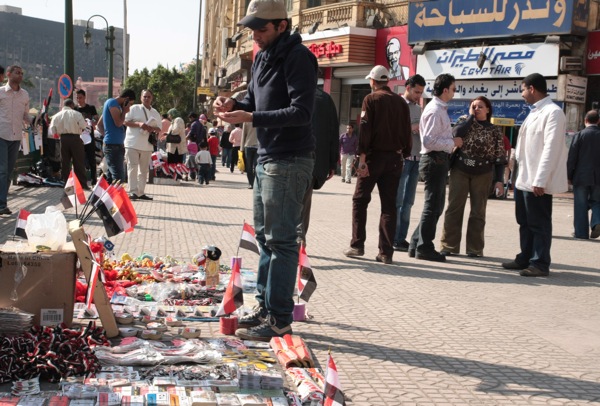
Even the revolutionary merchandisers are mostly gone. Once it was nearly impossible to walk without stepping on their wares, spread out over the busy sidewalks around Tahrir Square; now there are just a couple left.
During the same week that the army re-landscaped Tahrir Square, a friend and I attended a performance of jazz songs at The Culture Wheel. During intermission, my friend remarked that the auditorium was more than half full for a minor culture event; she speculated that people were letting go of the revolutionary adrenalin and learning to take pleasure in more prosaic events, and that this was a healthy sign.
The revolution does not feel over or stalled. It does feel as though it has entered a new phase – perhaps a more mature one. The interim government seems to be responding to some of the activists’ calls – by detaining and/or investigating Mubarak’s sons and cronies for corruption and profiteering. Some of the detained activists have been released. Onerous restrictions that made registering a newspaper nearly impossible under Mubarak were recently lifted. The courts ordered the NDP, Mubarak’s party, to be dismantled; the party’s power structure remains, but that could be a temporary matter. Or not.
On the other hand, the Emergency Laws are still in place and Amnesty International just released a report that describes a continued pattern of “torture, arbitrary detention, trials of civilians before military courts and repression of freedom of expression by authorities.” Amnesty’s UK director, Kate Allen, sums up post-Mubarak Egypt thus: “The uniforms have changed but we’ve seen the same patterns of abuse continue.”
So are we seeing a consolidation of military rule or a bumpy transition to a democratic state – which will no doubt be as imperfect as most democracies? After five weeks of talking to academics, analysts, politicians and journalists, there is only one answer: No-one knows.
Elections are supposed to be held in September. Ramadan begins in mid-August, with a month of daytime fasting and late-night celebrating at the height of summer. Between now and mid-September, the many political parties that have begun to gather supporters and stake out their positions will have to register and campaign. Today, on Easter Monday / Sham el-Nissim (holiday of the spring), with the city quiet and most people out enjoying the day off, it feels as though everyone is taking a deep breath and gathering energy for the next phase of the revolution.