After taking part in a protest action challenging the checkpoint and permit regime in Bethlehem, one activist finds herself in a home where the reality of the occupation comes to life in a way that ‘breaks your heart while punching you in the stomach as you stare at it.’
By Leehee Rothschild
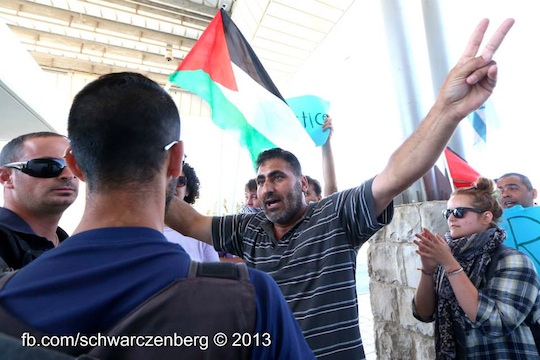
We went to Bethlehem yesterday for a direct action where a group comprised mostly of Palestinians, along with several Israelis and internationals, tried to walk across the Bethlehem checkpoint and visit Jerusalem. The Israeli army stopped us as we reached the checkpoint and prevented us from continuing on our way. Some of the soldiers engaged in some form of dialogue with us, while shoving the Palestinian activists away from the checkpoint. Most of them kept repeating that they were “just following orders.”
One female soldier asked her commander if she could use “reasonable force” against us, adding, “look at them, they look like animals.” She also stood there mockingly chanting “El el, Israel,” at the Palestinians, and became extremely agitated as I started to videotape her.
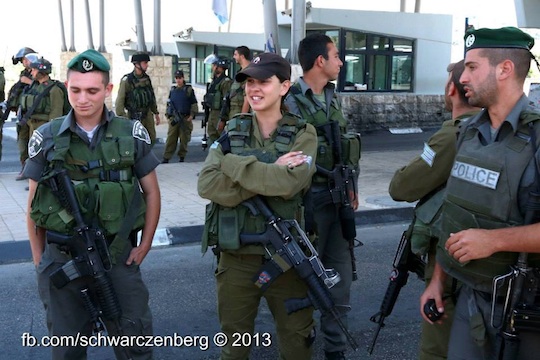
The soldiers quickly called for reinforcements, and eventually we found ourselves surrounded by dozens of soldiers and cops who looked like they were preparing to make arrests. At that point, three Palestinian activists declared that since they were not allowed to go pray in Al Aqsa (Jerusalem), they would pray right then and there at the checkpoint. They started praying, with Palestinian flags serving as their prayer rugs.
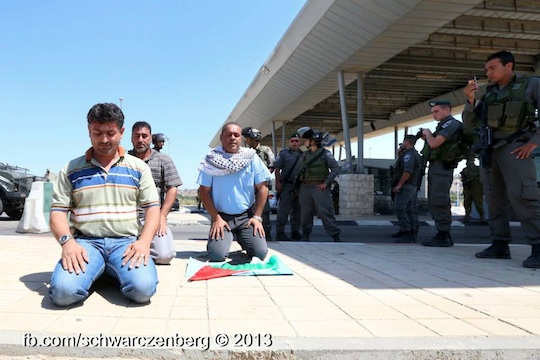
The soldiers, who assumed that the rest of the people present were journalists and foreigners, decided to refrain from arrests, since “it wouldn’t look good.” They did, however, follow us back to our cars to make sure we were really leaving. We did, but the Palestinian protestors voiced a promise: “Next time, we will pray in Jerusalem.”
It was an opportunity to see the reality of checkpoints and permits that reign over Palestinian lives under occupation, determining who can go where and when, separating Palestinians living in the West Bank from those in East Jerusalem, severing family ties and friendships, controlling movement and dictating professional and academic choices. It was also an opportunity to see apartheid in action, as settler cars drove by us throughout the entire encounter; the soldiers allowed them to pass through the checkpoint with hardly a second thought. At times, they complained about the inconvenience the Palestinian protestors caused them by blocking their road, while the protesters were demanding the right to travel on it. It was also one more opportunity to challenge the checkpoint regime, to expose its abnormality, cruelty and arbitrariness.
That said, the most meaningful and saddest moment of the day was later on when photojournalist Haim Schwarzcenberg took us to visit Claire’s house. Located just across from Rachel’s Tomb and not far from the Nativity Church, Claire and her family, Bethlehem natives, used to make their living from a gift shop and guesthouse catering to Christian tourists. Nowadays, the house is separated from Rachel’s Tomb by the wall, which encloses it from three directions, its huge form casting its shadow over the pavement. Claire told us yesterday, “no one comes this way, not even the alternative tour groups.”
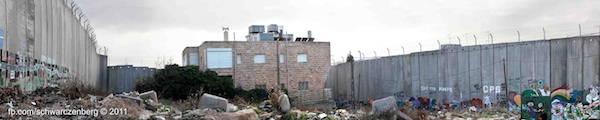
Like Shuhada street in Hebron, Claire’s house is one of those places in which all the horrors of the occupation come to life in a way that breaks your heart while punching you in the stomach as you stand there, looking at the house, surrounded by the wall. I have seen many things in my years as an activist: evils and wrongdoing, big and small. As I stood by Claire’s house, feeling the entire weight of the occupation in the grey concrete staring at me, I simply wanted to cry.
Leehee Rothschild has been active in the Palestinian struggle for over a decade. She currently works with Anarchists Against the Wall and Boycott From Within. She writes about activism and political struggle on her blog, Radically Blonde and other publications.