
There is much to say about the justness (or unjustness) of the Oslo process, specifically the economic and human impact it has had over the last two decades in Israel and Palestine. What follows is a snapshot.
By A. Daniel Roth
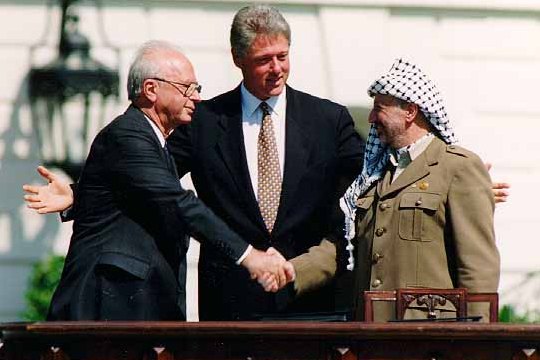
Twenty years ago this week Yitzhak Rabin and Yasser Arafat signed the historic Oslo Accords. A few months later, in the spring of 1994, the Paris Protocol – the blueprint that would define the economic relationship between the Palestinians and Israelis for the next two decades – was signed.
Continued violence and events such as the assassination of Prime Minister Rabin ensured that the conditions for a just peace between the two peoples would worsen over the next two decades. Despite the above, the power imbalance that gives Israel the vast majority of control over the Palestinian people and economy, and the intention that the protocol was only supposed to be valid for five years, the Paris Protocol remains central to the two peoples’ shared economic system. It’s a system that places the Palestinians almost entirely under the economic control of Israeli policy.
Read more: The festering legacy of Oslo: Jerusalem as ‘indivisible’ as ever
Israelis and Palestinians both use the shekel, but the difference in their economies is enormous. Israel’s per capita GDP is about $32,600, while Palestine’s is listed as $2,900. The Palestinian economy is small and relies almost entirely on Israel. About 72 percent of imports to Palestine come from Israel and about 90 percent of Palestinian exports wind up inside Israel.
In addition, the protocol ties the value added tax (VAT), a vital source of revenue for the PA, to Israel’s VAT. When Israel raises its VAT as it did, to 18 percent in June of this year, the PA must as well. The PA VAT sits at 16 percent. The agreement also led to the establishment of a Palestinian Finance Ministry and Central Bureau of Statistics. Still, Israel controls all ports of entry to Palestinian markets and population centers and collects the majority of import taxes on goods heading there, leaving Israel responsible for a great deal of PA government revenue. It’s a responsibility they don’t always follow through on.
One of the central components of the agreement stipulated that workers and goods would be able to flow throughout Israel and the occupied territories, but the flow of labor and goods significantly diminished in the fallout of the Second Intifada, before which about 110,000 Palestinians worked in Israel and Jewish settlements in the occupied territories. Today the number of Palestinians with Israeli work permits hovers around 35-40,000.
Indeed, a report from the UN’s conference on Trade and Development notes that restrictions on movement have contributed to the Palestinian trade deficit, which grew from 44 to 47 percent of GDP in 2012.
The report also notes that the building of the separation barrier, which began in 2003 – another measure in the wake of the Second Intifada – has led to $1 billion in losses to Palestinians in Jerusalem with $200 million added to that number each year. Commercial trade between Israelis and Palestinians was valued at $20 billion this year.
A recent International Monetary Fund report forecasts a dim outlook for the Palestinian economy. Two years ago the growth forecast for 2013 was 12 percent; now that number is set at 4.5 percent. About a quarter of Palestinians live below the poverty line. Meanwhile, a look at the Israeli side of things doesn’t reveal much better news: the Israeli poverty rate sits at 21 percent and further austerity measures are in the works.
As the occupation continues and as economic outlooks worsen for most people in Israel and Palestine, the economies of the two peoples remain intertwined. Whether the current round of negotiations can bring about a just solution – economic and otherwise – for both Israelis and Palestinians is yet to be seen. What is certain is that the Oslo process didn’t achieve it.
Related:
Oslo years, a view from the ground
A. Daniel Roth is an educator and journalist living in south Tel Aviv. He was born and raised in Toronto and lived in a commune of the Hashomer Hatzair movement in New York City. Daniel is a member of the All That’s Left collective. You can find more of his writing and photography at allthesedays.org. Follow him on Twitter @adanielroth.