
Those who believe it is possible to maintain an occupation without violence are wrong. The case of Ahed Tamimi illustrates why.
By Orly Noy
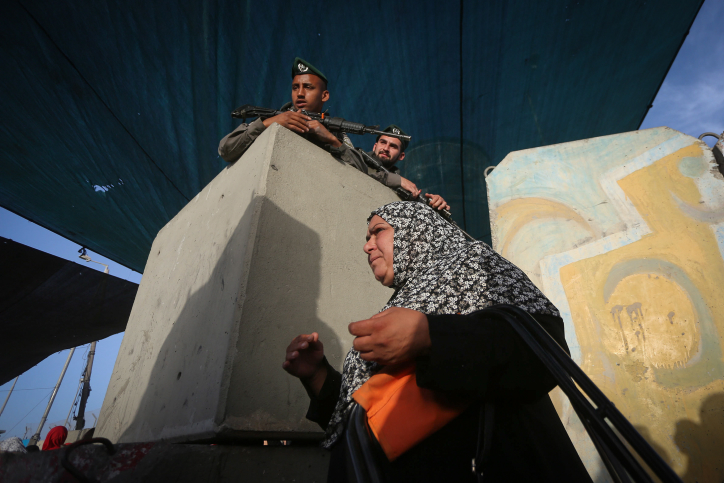
Israelis often claim that a soldier with the right moral education can operate a checkpoint without violating anyone’s rights. Many in Israeli media have made this claim with regard to the two soldiers filmed facing down Ahed Tamimi, the 16-year-old under arrest for shoving and kicking soldiers off the porch of her family’s home last week: that the soldiers demonstrated the good moral education they received, in the army or at home or both, by refraining from responding to Ahed Tamimi with violence.
I assume that there is some truth to these claims, especially in the reality of the occupied territories, where, in the eyes of the army, Palestinian lives are cheap. The fact that the two soldiers did not respond by beating Ahed Tamimi is indeed surprising in a reality in which soldiers shot and killed a wheelchair-bound protester in Gaza, and in which soldiers break into houses and arrest children in their beds in the West Bank. Without a doubt, it says something about those two soldiers. But it says something much bigger about this reality.
The case of Ahed Tamimi does away with the illusion of “the good soldier” at the checkpoint. It is possible that these soldiers acted the way they did because they feared being caught on camera, but it also very possible that these two soldiers came from good homes and believed in their hearts that they were “the good soldiers” at the checkpoint — the soldiers who act with humanity, who don’t beat, abuse, scream, or curse. It is absolutely possible that their morality is what prevented them from beating the girls who refused to accept the soldiers’ presence in their home.

Nonetheless, with all the morality and humanity they demonstrated, they were still two soldiers who broke into the house of a family that has been attacked for years by the army whose uniform they wear — and in an occupied territory where Palestinians barely have the right to breathe without an official permit. The two young men may have had pure, uncorrupted hearts, but they were dressed in the uniform of an army that has turned cruelty towards the lives of millions of Palestinians into something so natural that their refusal to act cruelly is considered by the Israeli public as something unnatural.
The two soldiers may have acted according to their consciences in refusing to beat Ahed Tamimi, but the army in which they serve later broke into the Tamimi home in the middle of the night to arrest Ahed, and then arrested her mother when she accompanied her daughter to the police station. In other words, regardless of their best intentions, their encounter with the Tamimis began with violence and ended with violence. From the moment they put on their uniform, their ethical sensibilities ceased to be a factor.
Each and every Israeli young person preparing for the draft should take this into account. Participation in the occupation begins the moment you put on a uniform. You cannot — ever — be the good soldier at the checkpoint because the checkpoint was not supposed to be there in the first place. The very fact of your presence in someone’s house, who has the right to live without fear of being raided by the army at any hour of the day, strengthens the essence of the checkpoint and legitimizes it. When you wear the army uniform, your body becomes the checkpoint. There is no way to be the “good soldier.”
This article first appeared in Hebrew at Local Call. Read it here.