

The Netanyahu government is celebrating Trump’s recent declaration and threats against the Palestinians as victories, but Jerusalem should wait before opening the champagne.
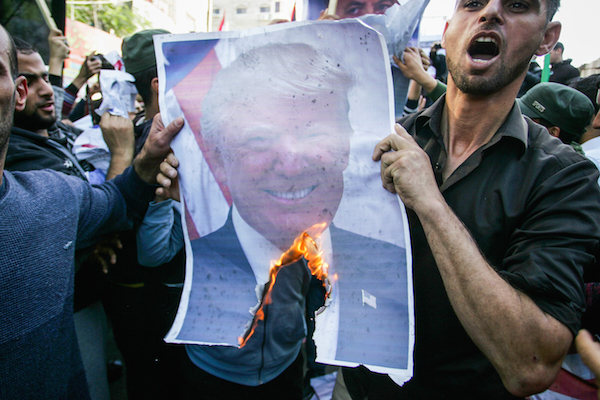
The Trump Administration on Tuesday threatened to withhold millions of dollars in aid that it sends to the Palestinians each year, accusing them of not wanting to negotiate a peace deal with Israel.
Nikki Haley, the U.S. Ambassador to the United Nations, said the U.S. would stop funding the United Nations Relief and Works Agency (UNRWA) — the UN agency responsible for providing aid to Palestinian refugees — if the Palestinian leadership refuses to return to American-led peace talks. Washington is the agency’s biggest donor; it sends around $300 million a year to the agency, roughly a third of which is designated for aid to residents of refugee camps in the West Bank and Gaza.
It possible that the U.S. president’s threat included Washington’s aid to the Palestinian Authority, which amounts to another $300 million dollars or so a year. The Trump administration has presented these threats as a response to the Palestinian leadership’s decision to reject continued American stewardship of the peace process. That decision was itself a response to Trump’s recognition of Jerusalem as Israel’s capital and his commitment to move the U.S. embassy from Tel Aviv to Jerusalem.
While Trump’s threats may be intended to punish the Palestinians for their lack of “appreciation or respect” for U.S. leadership in the region (as the president tweeted), his threats should also worry Israel.
Until the signing of the Oslo Accords, Israel was responsible for managing the day-to-day lives of Palestinians in the occupied territories. Infrastructure, welfare, education, health, and other services were all Israel’s responsibility as the occupying power. Oslo transferred much of that responsibility to the newly created Palestinian Authority, and the two sides passed on the bill to the international community—mainly the U.S., European Union, and Arab states. The idea was that foreign aid would act as a crutch to enable Palestinian development while the occupation came to an end and an independent Palestinian state rose in its place. In parallel, UNRWA would continue to provide aid to 810,000 people in the West Bank alone, operating 19 refugee camps, 96 schools, 43 medical centers, and more.
The peace process died and was buried, and yet the Oslo Accords—designed as an interim agreement meant to end in 1999—continue to serve as the loose framework for relations between Israel and the Palestinians. The U.S., the E.U., and the Arab states have continued to fund the PA and UNRWA, while allowing Israel to maintain the occupation under “luxury” conditions: full control of the territory, full control over the lives of the people, but without any responsibility for them and without being burdened with any serious cost. The justification for that arrangement’s continued existence was the illusion of a peace process. For the past 25 years, half the duration of the occupation, peace was supposed to come at any moment.
But now Trump has changed the equation: if the Palestinians refuse to accept Washington’s leadership of the peace process and its conditions, then there shall be no peace process, and therefore no funding to the PA and UNRWA. The problem is that if there is no peace process, and therefore no funding, then the PA and UNRWA will have to cut their services—close schools, and fire employees—and they alone will not pay the price. Angry protests in response would likely be aimed at Israel, or could undermine the PA’s strength and legitimacy.
Cuts to the PA budget and protests in the street would also likely affect the PA’s security forces, which essentially serve as Israel’s security contractor on the ground, and whom the Israeli defense establishment relies on to keep the peace and help prevent terrorist attacks. In short, one way or another, cutting off the PA’s main sources of funding will erode the framework that has until now sustained Israel’s occupation deluxe.
Trump threatens to shatter not only the underlying assumptions of the framework that subsidizes the Israel occupation (through Palestinian institutions and the UN), but also the illusion of a peace process and the two-state solution (which Netanyahu’s Likud party rejected, again, this week). The Netanyahu government may see these changes as a victory, but in the long-term it is difficult to know where the collapse of the status quo will lead. Israel’s leadership should wait before popping open the champagne.


