Many have argued that the US is no longer a neutral broker between the Israelis and the Palestinians. I’ll take it one step further: is English even the appropriate mediating language?
William Shakespeare famously asked, “What’s in a name?” I (less famously) will ask, “What’s in a language?”
Today, I called the mobile provider Orange to argue about my bill. I was asked to provide them (again) with my email address. Me spelling it out went something like this…
Me: “R” for Roee, Romeo, like the Hebrew letter “raysh”
Orange agent: “M?”
Me (thinking to myself): “How the #$%W#$ did you get M from that?””
Me (actually saying): “No, R … for Roee, Romeo, Race, Ranch, Raysh.”
Sounds silly, but it reminds me of the miscommunications between the Israeli officials who travel to Washington and their American counterparts, a frustration that has been expressed by the latter. The Israelis are so insistent they speak English. But really, except perhaps for Pennsylvania-raised Netanyahu, what most are doing is speaking Hebrew with English words.
There’s a joke: an Israeli contractor bids for a building. He’s asked by the client, “How much?” The client says (in Hebrew, using English words), “Roof? One million.” The client thinks to himself, “Wow, if only the roof is a million, I can’t imagine how much the rest of the building will cost,” and walks away from the deal. (In Hebrew, gag means “roof,” but it also means “maximum” or “tops.”)
I wonder if peace would have been achieved years ago if Israel’s English-speaking diplomats would have just spoken Hebrew and used translators. At minimum, it might have spared years of misunderstandings.
A second anecdote: I heard a rumor that when you have US dollars in your Israeli checking account, and then withdraw them, they are first converted to Israeli shekels and then back to US dollars. Obviously, you lose a lot in the conversion. I wonder if, when the Israelis and the Palestinian negotiate via an English-speaking mediator, there’s some (lots?) of value lost, as well?
Language is clearly important. I have long argued that Israel’s schools should be fully bilingual, and that language should not be segregated. Considering that the schools themselves are segregated, the language discussion is a long way off the table. And … it’s not guaranteed to solve anything. In Belgium, the Flemish and Wallonians speak each other’s native tongues and they still can’t get along. But one would think that Israelis, living in the neighborhood that they do, would be keen to learn the language of those living in the region. I have suggested it to some here in Tel Aviv and I mostly received vehement opposition, though I am not sure why.
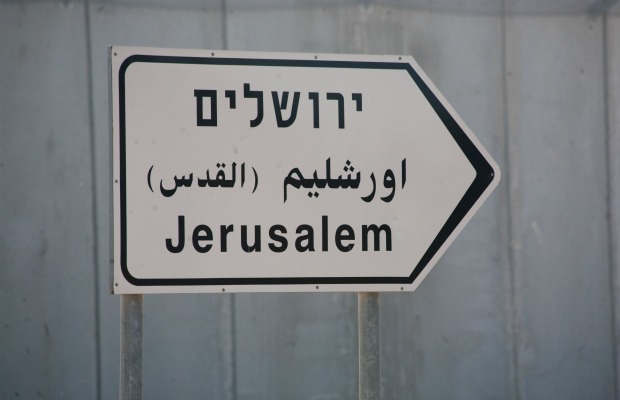
But nothing is uncomplicated in this region. Even the language of signs is controversial, as evident by the Arabic spelling of Jerusalem. In Arabic script, it phonetically reads: “Urshaleem,” almost like in Hebrew. The actual commonly used Arabic name for the city, Al Quds, appears in parenthetical notes (perhaps as a sort of conciliatory gesture). Interestingly, in English, the name is not written phonetically. Unless there’s a double-standard, in theory, it should be.