

West Bank village wakes up to no water

The municipal council of Qarawat Bani Hassan was not warned that their water supply was going to be nearly shut off for days, and attempts to get answers from Israel, through the Palestinian Authority, did not bear any fruit.

Text and photos by: Ahmad al-Bazz / Activestills.org

Palestinian child carries water gallon in Qarawat Bani Hassan village, West Bank, May 23, 2015. According to the municipal council of Qarawat Bani Hassan the portion of a each villager has decreased to two litters per day as the village receive only 97 Cubic meter per hour. The municipal council said the Israeli authorities did not provide the village with answers regarding the situation. Ahmad al-Bazz / Activestills.org
A Palestinian child carries a water container in Qarawat Bani Hassan village, West Bank, May 23, 2015. Ahmad al-Bazz / Activestills.org

Last Wednesday, without any prior warning, the majority of houses in the West Bank village of Qarawat Bani Hassan, near Salfit, woke up to find that they had no running water. Municipal workers checked the village’s main water valve, located on Road 505, a few meters from the illegal Israeli settlement outpost of Ma’ale Israel.

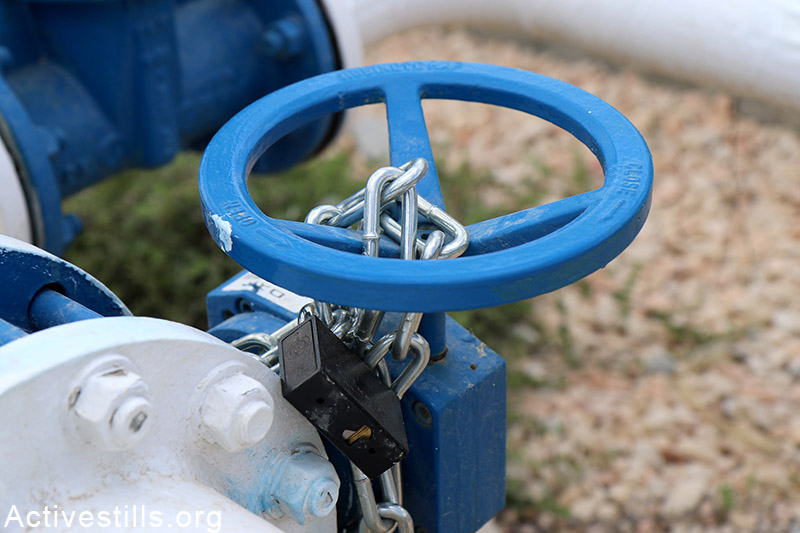
“We discovered that the main water valve was almost shut off, [and locked in place] with a lock and chain in order to limit our portion of water and prevent anyone from increasing it,” said Hosam Asem, the manager of Qarawat Bani Hassan municipal council.

“We contacted the Israeli side through the Palestinian authority but we didn’t get any answers or explanations for such a step,” He added. “It’s odd that the Israelis didn’t inform us beforehand.”
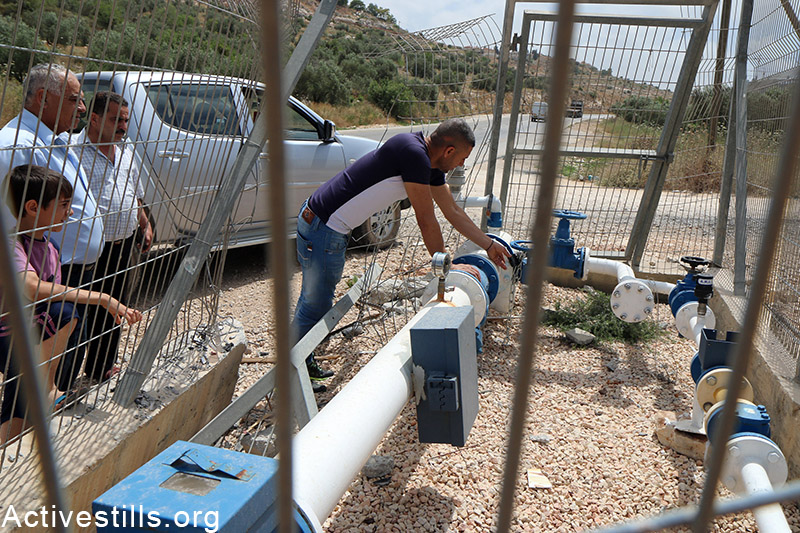
Palestinian checks the main water valve, now almost closed by Israeli authorities, in Qarawat Bani Hassan village, near Salfit, West Bank, May 23, 2015. According to the municipal council of Qarawat Bani Hassan the portion of a each villager has decreased to two litters per day as the village receive only 97 Cubic meter per hour. The municipal council said the Israeli authorities did not provide the village with answers regarding the situation. Ahmad al-Bazz / Activestills.org
A Palestinian man checks the main water valve, now almost closed by Israeli authorities, in Qarawat Bani Hassan village, near Salfit, West Bank, May 23, 2015. According to the municipal council of Qarawat Bani Hassan the portion of a each villager has decreased to two liters per day as the village receive only 97 cubic meters per hour. The municipal council said the Israeli authorities did not provide the village with answers regarding the situation. Ahmad al-Bazz / Activestills.org
The main water valve of Qarawat Bani Hassan village, near Salfit, is seen almost blocked by Israeli authorities limiting the water supply to the village and nearby villages, West Bank, May 23, 2015. According to the municipal council of Qarawat Bani Hassan the portion of a each villager has decreased to two litters per day as the village receive only 97 Cubic meter per hour. The municipal council said the Israeli authorities did not provide the village with answers regarding the situation. Ahmad al-Bazz / Activestills.org
The main water valve of Qarawat Bani Hassan village, near Salfit, is seen largely shut by Israeli authorities limiting the water supply to the village and nearby villages, West Bank, May 23, 2015. Ahmad al-Bazz / Activestills.org

According to the municipal council, the supply of water for each villager has now been reduced to about two liters per day, as all of the neighboring Palestinian villages now receive a total of 97 cubic meters per hour. The four surrounding Israeli settlements, Barkan, Revava, Kiryat Netafim and Ma’ale Israel were reportedly not affected by the crisis.

Those villagers who own small water wells beside their homes decided to put them to use, while others were forced to buy water in tanks from other villages. After four days, 90 percent of the homes were back to being supplied with the normal amount of water. The remainder were still waiting a solution for their problem.

According to Ewash, Palestinians currently utilize no more than 10 per cent of the West Bank’s shared water resources, while Israel exploits the remainder. The coalition of 27 organizations working in water and sanitation in the occupied territories argues that under international law, the water resources should be shared equitably and reasonably by Israel and Palestine. The average domestic consumption rate for Palestinians living in the West Bank is 70 liters per day. The “absolute minimum” recommended by the WHO is 100 liters per day. In Israel, the average is 300 liters per day.
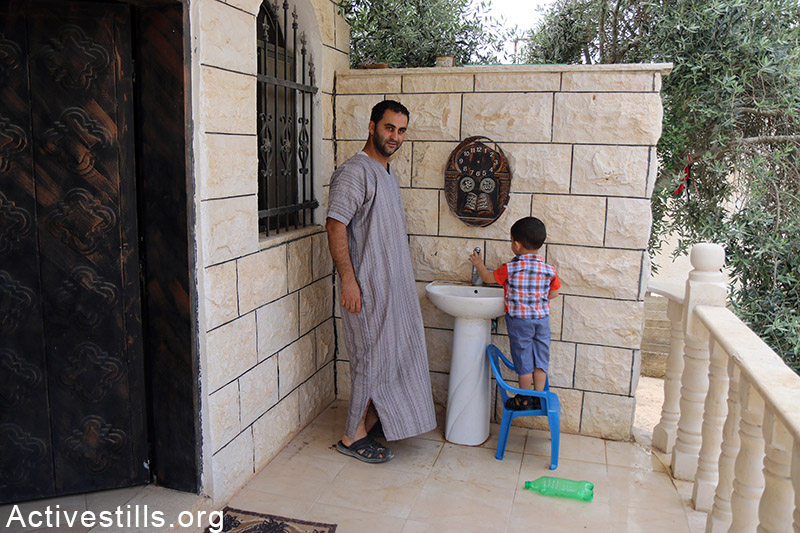
Palestinians check tap water volume in Qarawat Bani Hassan village, West Bank, May 23, 2015. According to the municipal council of Qarawat Bani Hassan the portion of a each villager has decreased to two litters per day as the village receive only 97 Cubic meter per hour. The municipal council said the Israeli authorities did not provide the village with answers regarding the situation. Ahmad al-Bazz / Activestills.org
Palestinians check the water pressure in Qarawat Bani Hassan village, West Bank, May 23, 2015. Ahmad al-Bazz / Activestills.org

End of article module for Members

TEST TEST GAL Our team has been devastated by the horrific events of this latest war. The world is reeling from Israel’s unprecedented onslaught on Gaza, inflicting mass devastation and death upon besieged Palestinians, as well as the atrocious attack and kidnappings by Hamas in Israel on October 7. Our hearts are with all the people and communities facing this violence.    We are in an extraordinarily dangerous era in Israel-Palestine. The bloodshed has reached extreme levels of brutality and threatens to engulf the entire region. Emboldened settlers in the West Bank, backed by the army, are seizing the opportunity to intensify their attacks on Palestinians. The most far-right government in Israel’s history is ramping up its policing of dissent, using the cover of war to silence Palestinian citizens and left-wing Jews who object to its policies.   This escalation has a very clear context, one that +972 has spent the past 14 years covering: Israeli society’s growing racism and militarism, entrenched occupation and apartheid, and a normalized siege on Gaza.   We are well positioned to cover this perilous moment – but we need your help to do it. This terrible period will challenge the humanity of all of those working for a better future in this land. Palestinians and Israelis are already organizing and strategizing to put up the fight of their lives.   Can we count on your support? +972 Magazine is a leading media voice of this movement, a desperately needed platform where Palestinian and Israeli journalists, activists, and thinkers can report on and analyze what is happening, guided by humanism, equality, and justice. Join us.

Make a Donation