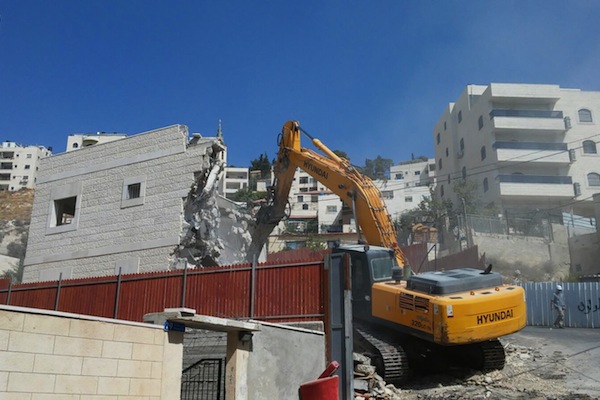
In East Jerusalem, entire families have their homes demolished and are thrown into the street. Just a few miles away, Israelis live without having to worry about losing everything they have.
By Sahar Vardi
Two children in uniform came down from the second floor to say hello to us before our ride left. With broken Arabic I asked the older one, who was all smiles, what his name is and his age. He is four, his younger brother is three.
I tried to ask the younger one for his name, but he only stared at me. His mother tried to convince him to answer me, but all he could say was “I just want my home.” And that’s it. That’s all the three year old had to say. He wants his home.
Hours before, at 4:30 a.m., I woke up in my West Jerusalem home. At some point I found myself staring at the kitchen while trying to fight my desire to go back to bed and make up hours of lost sleep.
Suddenly I noticed how many objects make up my kitchen. Not only furniture, but hanging cups, magnets on the refrigerator, memories, smells, millions of colors and shapes that create the feeling I wait for every time I come home from a long ride. Home. For a moment I tried to imagine how everything would look when destroyed. I tried to imagine the long arm of a bulldozer smashing through counter and colorful cups.
An hour later I was already at the boys’ home, where a total of 15 people lived, in Jerusalem’s Ras al-Amud neighborhood. We sat on sofas around a dining table in an empty home — bereft of furniture, windows, and doors. They cleared out everything, anything that could be salvaged.
When the police began to gather around the bulldozer in the nearby junction, a few young people from the neighborhood helped the homeowners to uproot the gate at the entrance to their home, as well as the parking gate, and lay it down in the nearby alley. This is hat a naked home looks like — and yet, it is still a home.
Fortunately, when the police arrived Samir, the three year old, was no longer home. A group of armed riot police officers went up to the second floor, where two other brothers, some of their friends and we were staying, and ordered everyone to leave.
One of the brothers looked through the house one more time, and all of us exited without saying a word. The officers created a “sterile” zone around the home, a municipality inspector came to take photos, while an electrical technician climbed on to the roof to disconnect the house from electricity, while the bulldozer crawled to a stop outside the home.
Two middle school-aged children, and two pairs of parents, along with the rest of their family members, stood and watched as the bulldozers raised its arm toward the window of the living room on the second floor.
The cries that were heard as the bulldozer began pounding into the wall was heartrending. It went on and on. A little over an hour in which the bulldozer went from room to room, and the family, friends, and neighbors looked on helplessly.
The final wall came crashing down, the bulldozer retreated, the inspector snapped a few photos. The police marched back to their vehicles and disappeared. Within 20 seconds, the young people of the neighborhood began cleaning the road, throwing pieces of the house into a giant pile that — just an hour prior — had been a home. They swept the pieces of asphalt that the bulldozer left on the road, and that was it. The road reopened to traffic and the crowd dispersed. Everyone went back to their homes, apart from those who were left homeless.
I didn’t stick around to see Samir come back from pre-school. I did not stick around to see how his mother try to explain what happened. And maybe there is no need, he probably understands better than all of us.
Sahar Vardi is an activist based in Jerusalem. This article was first published in Hebrew on Local Call. Read it here.