
The Holocaust lends itself perfectly to Israel’s two reigning ‘isms’ – nationalism and emotionalism.
Aren’t historic events supposed to diminish in their impact over time? Not the Holocaust, not in Israel. Today’s Holocaust Remembrance Day just seems bigger, more enveloping, more sanctimonious, more commanding than ever.
John Kerry just arrived last night to kick off what is supposed to be the Obama administration’s last-gasp attempt at Middle East peacemaking, and I open up Yediot Aharonot – which, along with Channel 2, is the most accurate reflection of the Israeli public’s personality – and it’s page after page after page of Holocaust – more than half the paper. I don’t remember Israeli newspapers giving that much space to Yom Hashoah. Even Haaretz went to town today.
The official explanation for this would be that the Holocaust survivors are dying of old age and soon there won’t be any of them left, so this is a way of hanging onto to them, or showing them respect at the end of their lives. But knowing how Israel has treated Holocaust survivors over the decades, especially when they first arrived, I’m not convinced. I think the reason for this counter-intuitively growing impact of the Holocaust, and by extension Yom Hashoah, is because it lends itself perfectly to the two reigning “isms” in this country – nationalism and emotionalism.
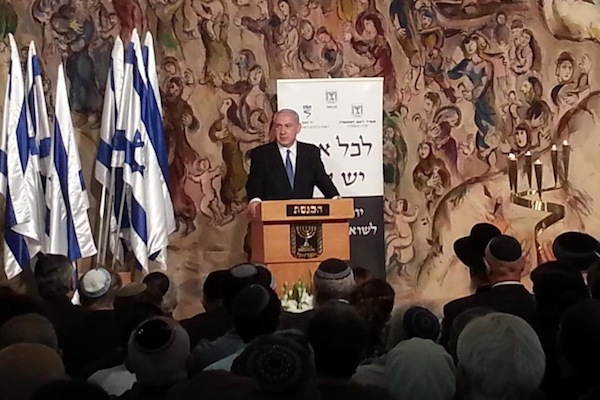
The connection between nationalism and the Holocaust isn’t new, of course, but with Bibi Netanyahu settling into his third term as prime minister, the association has become so much more raw and crude than ever before. Last night at Yad Vashem, Netanyahu delivered his annual Yom-Hashoah-bomb-Iran speech, and nobody raised an eyebrow – it’s become a ritual, like matza on Passover, and the idea of using the Holocaust to beat the drums for war with Iran has become so matter-of-fact around here, so embedded in the culture, that nobody notices it anymore.
The other factor in the Holocaust’s increasing impact – the rise of emotionalism, of tear-jerking as the key to mass appeal – is relatively new in this country. It “arrived” in full form with the campaign to free Gilad Shalit. As I wrote a few months ago (in a post focusing on the now-infamous craze of Holocaust survivors’ grandchildren tattooing their grandparents’ concentration camp numbers on their arms, or their ankles), my son reported that on his high school class trip to Poland, the agenda wasn’t to turn the kids into combat soldiers, but to turn them into a blubbering, hugging therapy group.
What’s a more emotional story, what’s more up-close-and-personal than the Holocaust? It’s the most written-about, dramatized, black-and-white, good-vs.-evil, awesome, tragic story in history – and it’s ours. For the media, for politicians, for anybody who wants to appeal to the Israeli public, the Holocaust, as they might say in America, is huge. As they might say in Israel, it’s a shlagger. It’s like Elvis, or Marilyn Monroe – an eternal superstar. I don’t think the aura is ever going to fade – there will always be a 70th, a 75th, an 80th, a 100th anniversary of Kristallnacht, or the Wannsee agreement, or the Nazis’ surrender, or some other day to publicize. For Holocaust Remembrance Day next year, maybe Yediot will put out a special memorial edition; I’m sure it will sell like hotcakes.
I actually think Israel should observe Yom Hashoah and there should be a siren during which everyone stands still and silent. The catastrophe and its victims shouldn’t be forgotten. But Yom Hashoah didn’t used to be like this – it didn’t used to be such a festival, such an affair. There wasn’t this built-in escalation, the determination that this year’s show has to be better than last year’s. There wasn’t such exploitation – neither for the sake of politics or entertainment.
I can’t stand the term “Holocaust” anymore – it’s become a brand name, the whole subject has become “branded.” Yom Hashoah has turned into some kind of Holocaust Experience. Again, this is not new, it’s just gotten palpably worse.