
Nine families are made homeless in a series of demolitions in East Jerusalem. The pace of demolitions so far in 2017 outstrips that in 2016, currently the worst year on record.
By Aviv Tatarsky
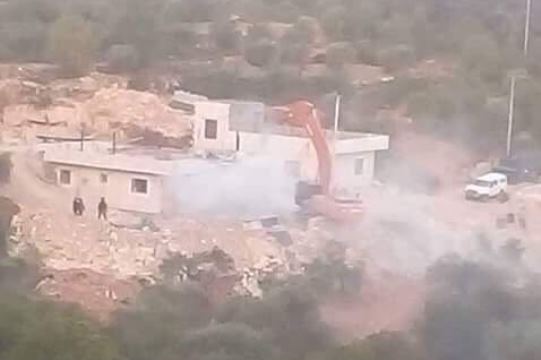
Israeli forces conducted a wave of demolitions in East Jerusalem on Thursday, destroying four homes in al-Walaja, one house and four apartments in a-Tur, one apartment in Sur Baher and three garages in Issawiya. Nine families lost their homes as a result.
It was an especially difficult day, but one in keeping with an ongoing phenomenon over the past two years. Israel has significantly stepped up its demolition of homes in the occupied territories, destroying 123 housing units in Jerusalem in 2016 — a record, and more than double its prior yearly average. Israel demolished 66 housing units in East Jerusalem during the first four months of 2017, a pace which, if maintained, would make 2017 a far worse year than the one before.
Last year was also the first in which Israel destroyed homes in East Jerusalem neighborhoods cut off by the separation wall, which brings us back to al-Walaja — where, a week ago, construction of the barrier resumed.
The demolitions were carried out in the part of al-Walaja that has been annexed to Jerusalem. Despite its annexation, the municipality and the state have never provided even a semblance of services to the village. Yet Israel insists on demolishing buildings constructed without a permit — which itself is a result of the government not approving a master plan for the village.
The separation wall has caused considerable damage to the groves that al-Walaja’s residents use to support themselves, and has taken away 1,000 dunams (247 acres) of land that remained on the Israeli side of the fence. The area will now become a national park for the enjoyment of Israelis.
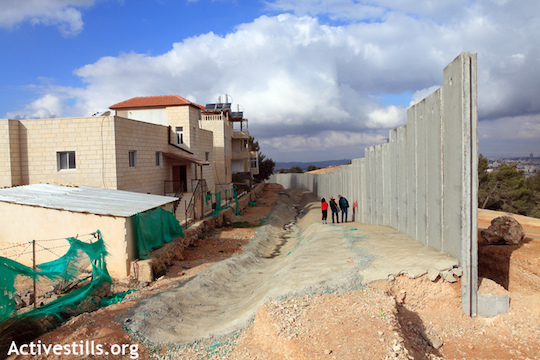
The separation fence will also physically cut al-Walaja off from Jerusalem, another step in the ongoing disregard of its residents’ existence. But in spite of the physical separation, Israel is determined to “maintain the connection” by way of demolishing homes in the village. Dozens of families in al-Walaja are living in homes under threat of destruction.
While exact details of the affected families are still unclear, the nature of the threat is stark, and the maliciousness of the demolition policy in al-Walaja, East Jerusalem and Area C is unmistakable. Thousands have been made homeless by demolitions in the last two years, with the underlying goal of expelling the Palestinian population to the Area A and B enclaves throughout the West Bank.
Also evident is the despair — and apathy — of al-Walaja’s residents, who no longer have the strength to tackle the violence against them, and who have no hope that positive change is on the horizon. The building of the wall, demolitions, land theft — all are surrendered to, with no attempt at opposition and no community organization that can put a stop to the blows raining down on the village.
The hardening of Israeli hearts is clear as well. The only thing that rivals this impenetrability is the smugness of being “the most moral people and the only democracy…” We don’t want to know, and even if we are forced to address these crimes, most of us set out to blame the victims.
Al-Walaja can be seen from numerous Jerusalem neighborhoods: Gilo, Malha, Ir Ganim, Katamonim, Aminadav, Talbiya. Thousands of Jerusalemites went out from their homes on Thursday morning, as the demolitions were in progress. They looked over toward al-Walaja, and they didn’t see a thing.
Aviv Tatarsky is an activist with Engaged Dharma Israel.